
Trade Watch: Oil at $78 Is Priced Between Two Worlds — and the Middle Rarely Holds
Brent jumped 6% in a day as the US-Iran ceasefire collapsed — one week after analysts warned of a supply glut. Both stories are true, and that contradiction is the trade. A framework for thinking about oil when the market can't decide which world it lives in.

Educational market analysis only. Not financial advice.
A week ago, the story in oil was oversupply. Brent was drifting near five-month lows around $72, OPEC+ had just agreed to add another 188,000 barrels a day from August, and J.P. Morgan's research desk was reiterating a forecast of Brent averaging around $60 for 2026. The EIA's July outlook went further, projecting that global oil demand will actually shrink by roughly 1.2 million barrels a day this year — a rare contraction, driven by the demand destruction that months of wartime fuel prices left behind, particularly across Asia.
Then this week happened. Iran struck three tankers in the Strait of Hormuz. The US responded with strikes on more than 80 targets — air defenses, coastal radars, and over sixty of the Revolutionary Guard's small boats. Iran fired back at US military sites in Bahrain and Kuwait. Washington revoked the sanctions waiver that had allowed Iranian crude back onto world markets. And President Trump, speaking at the NATO summit in Ankara, declared the June ceasefire memorandum effectively dead. Brent jumped 6% in a single session to around $78, capping a move of nearly 10% in a week.
Here is what makes this moment analytically interesting, and why it's the subject of our first Trade Watch column: both stories are still true at the same time. The glut is real. The war premium is real. And a price of $78 is not a verdict on either — it's an average of two worlds that cannot coexist.
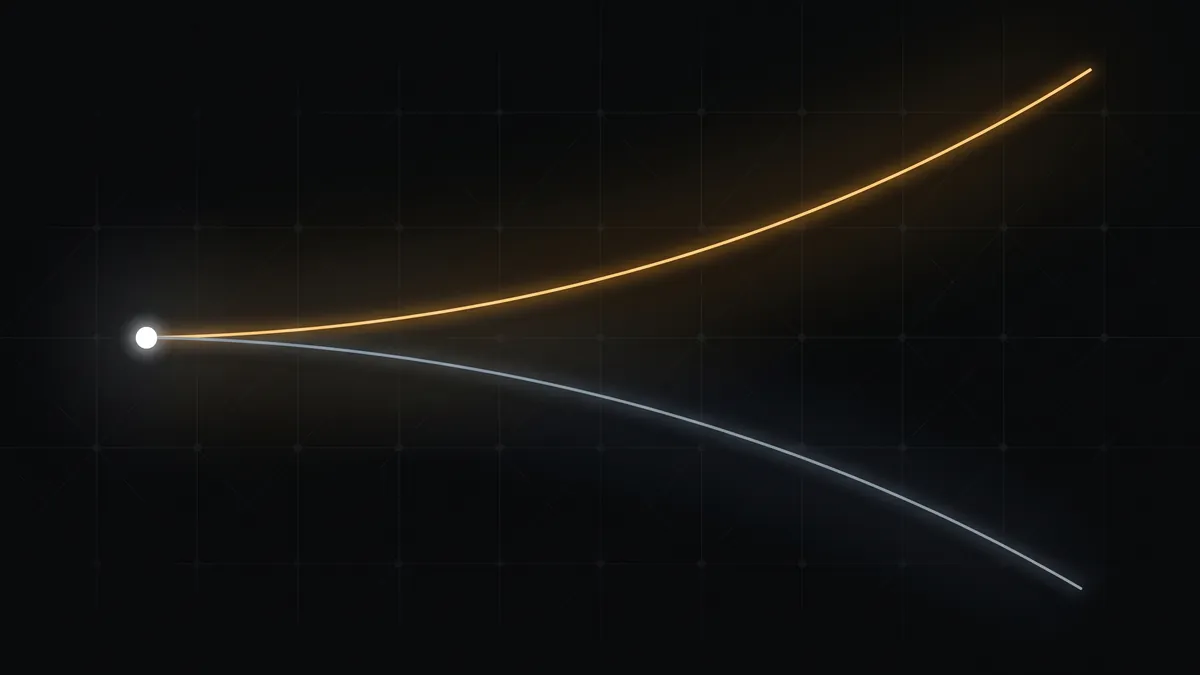
The two worlds
World A: the glut. If diplomacy is somehow rescued — talks were making progress in Doha barely a week ago — the fundamentals underneath this market are unambiguously heavy. Demand is contracting for the first time outside a global recession. OPEC+ is adding supply into that contraction. The UAE has restored exports to pre-war levels partly through pipeline routes that bypass Hormuz entirely. ING estimated back in February that the market was carrying roughly $10 a barrel of pure risk premium; strip that out and layer on the surplus, and the major-bank consensus clusters around $60–65 Brent. In World A, $78 is roughly $15 too high.
World B: the war. If this week's exchange of strikes marks the true end of the ceasefire rather than a violent negotiating tactic, the supply math changes in kind, not just degree. The sanctions waiver revocation takes real Iranian barrels off the market — that's physical supply, not sentiment. Maritime security analysts note that all three transit routes through the strait are likely closed for now, and that shipowners are beginning to judge the pirate-and-Houthi-threatened Red Sea as safer than Hormuz — a remarkable statement about how risk perception has inverted. For calibration: Brent averaged $85 in June while the strait was partially functioning under the MoU, and wartime peaks earlier this year ran far higher. In World B, $78 is cheap.

The honest answer to "which world are we in?" is that nobody knows — including, visibly, the market itself, which repriced the same barrel of oil by 10% in a week without a single new fact about production capacity or demand emerging. What changed was probability weights, not fundamentals.
Want to pressure-test the tail scenarios yourself? Our Risk Monitor lets you model blockade severity, duration, and strategic-reserve response against live Brent pricing.
Why the middle is the least stable place on the chart
This is the core insight of the week, and it's worth sitting with: $78 may be the single least likely price for oil to settle at. It's not a fair-value estimate for either world — it's a probability-weighted blend of roughly $60-something and $90-plus. Blended prices are stable only as long as uncertainty itself is stable. The moment the situation resolves in either direction — a genuine return to talks, or a definitive collapse into reopened war — the price doesn't drift, it jumps to the fundamentals of whichever world won.
Markets in this condition have a name in the derivatives world: they're convex. Large moves in either direction are more likely than the calm middle persisting. And that shapes how experienced traders tend to think about expressing a view here — which brings us to the educational heart of this column.
Three ways traders approach a two-world market
What follows is a framework for understanding how professionals think about this situation — not a recommendation. Each approach carries real risk of loss, and what's appropriate depends entirely on individual circumstances we can't know.

Approach 1: Own the uncertainty itself (long volatility). The textbook expression of "I don't know which way, but I'm confident it moves" is buying options on both sides — an out-of-the-money call plus an out-of-the-money put, a structure known as a strangle. It profits if oil ends up meaningfully higher or lower than today, and loses if the price stays pinned near $78. The catch, and it's a big one right now: option prices already reflect this week's chaos. Implied volatility on crude options is elevated — mid-June readings on WTI options were already running above 50%, roughly double calm-market levels — which means the market is charging a steep entry fee for exactly this bet. Buying volatility after a 6% day is a bit like buying an umbrella during the storm: you can still get value from it, but you paid the storm price.
Approach 2: Defined-risk directional (spreads instead of outright positions). Traders who lean toward one world but respect the other tend to reach for spreads in this environment — for instance, a call spread (buying one call, selling a higher-strike call against it) for those leaning bullish, or the mirror-image put spread for those leaning bearish. The logic: selling the further-out option partially refunds the expensive volatility you're buying, capping both the cost and the maximum outcome. In a high-volatility regime, spreads are how professionals stay directional without paying the storm price for unlimited upside they may not need.
Approach 3: The discipline of not chasing. Perhaps the most underrated position this week is recognizing what not to do. Buying oil outright the morning after a 6% headline-driven spike has a poor historical track record — the risk premium that inflates on strike headlines can deflate just as fast on a single positive statement from Doha or Ankara, as this entire year has demonstrated repeatedly. February's ING analysis pegged the premium at $10; premiums of that kind have been built and demolished twice in the past month alone. A trader who believes in World B doesn't need to pay today's panic price to express it; a trader who believes in World A is being offered a better entry than last week, but into a market that can gap violently against them on any overnight headline. Position sizing — smaller than usual, with predefined exits — is not a footnote in this regime; it is the strategy.
Explainer: what is a "risk premium," exactly?

When analysts say oil carries a "$10 risk premium," they mean the market price sits above what supply and demand alone would justify — the extra being an insurance charge against something going wrong (in this case, the strait closing). The premium is real money, but it's built on probability, not barrels: it can vanish overnight on a diplomatic breakthrough without a single tanker changing course. That asymmetry — slow to build, instant to evaporate — is why chasing premium-driven rallies is treacherous, and why this column distinguishes carefully between price moves driven by barrels (like the sanctions waiver revocation, which removes physical supply) and moves driven by probability (like a presidential remark at a press conference). This week featured both, which is part of what makes it genuinely hard to read.
The calendar that decides which world wins
Watch these, roughly in order of importance:
Whether talks resume at all. The 60-day MoU window ran to mid-August; the US president has now called it over, but "over" has been declared and undeclared before in this conflict. Any confirmed return to Doha-style mediation is a World A signal and would hit the premium hard and fast.
Iranian oil flows under reimposed sanctions. The waiver revocation is the week's most underrated event — headlines went to the missiles, but the sanctions move is the one measured in physical barrels. Watch tanker-tracking data for how much Iranian crude actually comes off the water, and how much leaks through to China regardless.
OPEC+ behavior into August. The 188,000 b/d increase was agreed when the story was glut. If the group proceeds as planned into a war-premium market, that's a tell about how seriously producers take World B; if they pause it, they're voting for it.
The EIA's August 11 outlook. July's edition delivered the demand-contraction call. Whether that deepens or stabilizes tells you how much cushion World A's bearish floor really has.
Bottom line
The temptation after a week like this is to have a strong opinion about direction. Our view is that the more defensible position is a strong opinion about structure: this is a market priced at the average of two incompatible futures, volatility is expensive but movement is likely, and the professional playbook in that regime favors defined risk, smaller size, and patience over conviction bets at panic prices. The middle of the chart is crowded with people who need to be right. The edges are where this resolves.
We'll revisit this framework in next week's Trade Watch as the picture develops.
Disclaimer: HormuzEye provides educational and informational market analysis only. This content is not financial advice, not investment advice, and not a buy or sell recommendation. Oil markets are volatile and geopolitical events can change quickly. Always do your own research and consult a qualified financial adviser before making investment decisions.