About HormuzEye
Understanding energy beyond the headlines
At HormuzEye, we believe that the global energy market deserves more than breaking news and recycled headlines.
Our mission is to provide independent, well-researched analysis of the oil and natural gas markets, helping investors, professionals and decision-makers understand the geopolitical forces shaping global energy.
Depth over speed.
We don't sell certainty in a market defined by uncertainty.
We don't predict the future. No one has a crystal ball. HormuzEye exists to help readers understand complex energy markets, not to pretend tomorrow's oil price can be known in advance.
Instead, we connect the dots between geopolitics, supply and demand, shipping, sanctions, OPEC decisions, financial markets and macroeconomic developments, allowing our readers to make better-informed decisions.
Why HormuzEye?
The Strait of Hormuz is one of the world's most strategically important energy corridors. Every geopolitical development in the region has the potential to influence oil prices, natural gas markets, inflation and the global economy.
That's why we chose the name HormuzEye.
Our focus extends beyond the Strait itself. We monitor the entire global energy landscape, with oil remaining our primary expertise and natural gas serving as an increasingly important part of today's energy markets.
Why HormuzEye Exists
HormuzEye was founded in June 2026, in the middle of an exceptional crisis around the Strait of Hormuz. Markets were sometimes reacting to headlines by the hour, while calm, well-founded interpretation was much harder to find.
That gap is why HormuzEye exists.
We are a team of oil experts and people with a genuine passion for following energy markets. We follow oil, geopolitics, shipping, supply and demand, sanctions, OPEC and financial markets with one aim: not only to say what is happening, but to understand why it is happening, and what different scenarios could mean.
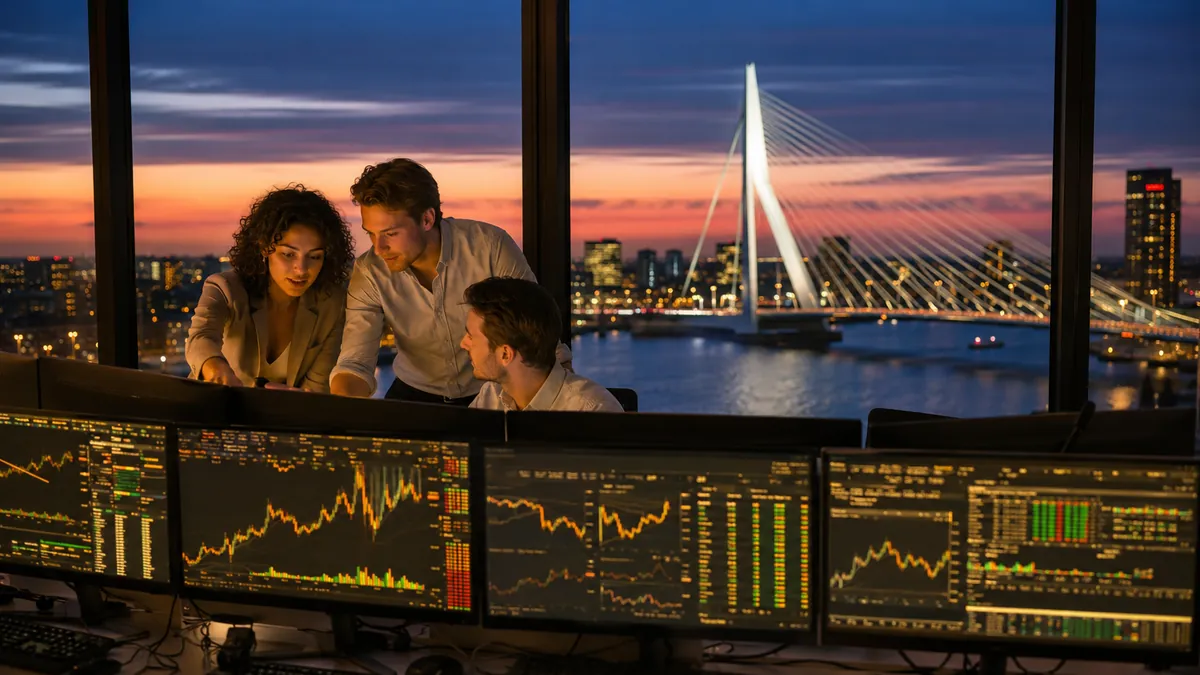
Our base is Rotterdam, Europe's largest oil port. That fits who we are. Rotterdam connects energy, refining, storage, trade and global shipping. The Strait of Hormuz is thousands of kilometres away, but a disruption there can ultimately be felt in European ports, businesses and markets.
Then there is forecasting.
Anyone who watches the oil market long enough learns, above all, how hard it is to predict. Major banks have research departments, international agencies sit on vast amounts of data, and market professionals follow oil every day. Still, no one has a crystal ball. Neither do we.
That is why you will never hear HormuzEye say "buy now" or "sell now."
We prefer to think in scenarios. What could happen? What would make a scenario more likely? What argues against it? What could change our current analysis entirely? And what could the consequences be for oil, energy and financial markets?
When the facts change, our analysis can change.
We do not see that as a weakness. That is exactly how good analysis is supposed to work.
Our approach
Depth over speed.
We don't simply report what happened.
We explain why it happened, what it means, what risks are developing beneath the surface and how different scenarios could affect energy markets.
That means asking what could happen, what conditions would make a scenario more or less likely, what could invalidate it, and what the consequences could be for oil, gas, shipping, geopolitics and financial markets. We prepare readers for possible outcomes rather than pretending to know which outcome will occur.
Our analysis combines multiple perspectives, including:
- Global geopolitics
- Oil and natural gas markets
- OPEC and producing nations
- Shipping and strategic chokepoints
- Financial markets
- Macroeconomic developments
- Energy security
Our goal is not to tell readers what to think.
Our goal is to give readers the information needed to think independently. Explore our latest energy analyses covering oil market analysis and geopolitical developments.
Sources & Methodology
We call HormuzEye an intelligence platform, and we use that word with some modesty. It is not a claim that we are smarter than the market; nobody is. It reflects how we work. You will never find us repackaging the day's headlines. Our aim is insight the headlines miss, often from an angle you did not expect.
AI-assisted research. Human judgement in control.
AI systems can help process large amounts of information, compare sources, identify inconsistencies, organise research, translate, explore alternative scenarios and challenge assumptions. They do not independently decide what HormuzEye believes, which sources to trust, how to interpret the evidence, or what gets published. Editorial judgement stays human. AI is a powerful research tool, not an oracle, and it does not remove uncertainty from the market.
We are deliberately not in the race to be first. Being first matters less than being right. When the Strait of Hormuz makes news, the core facts reach the wires within the hour; adding another echo helps no one. Our work starts where the breaking news ends: we take the time to understand what happened, weigh it against the data, and explain what it means.
Facts first. Interpretation second.
We distinguish between confirmed facts, credible reporting, estimates, forecasts, assumptions, scenarios and HormuzEye analysis. Fast-moving geopolitics is often messy. We may report an important developing claim while clearly labelling it as reported, unconfirmed, disputed or preliminary. We never present an unverified report as an established fact. Where the facts remain unclear, we say so rather than filling the gap with speculation.
Our analysis draws on official data (JODI, EIA, the IEA Oil Market Report, OPEC's Monthly Oil Market Report), maritime sources (AIS vessel tracking via MarineTraffic, UKMTO advisories, specialist tanker trackers), sanctions and government sources (OFAC, the U.S. State Department, the Congressional Research Service), market data (CME and ICE futures), quality journalism (Reuters, Bloomberg, the Financial Times, Lloyd's List, Al-Monitor) and think-tank research (CSIS, Atlantic Council, The Washington Institute), alongside the specialist energy community on X. We invest in high-quality input where it adds depth, and we attribute claims to their sources.
Based in Rotterdam. Watching the world.
HormuzEye is based in Rotterdam, one of Europe's most important energy, logistics and trading hubs.
Rotterdam connects global energy flows with European markets every day. While our perspective is international, being located in one of the world's major energy gateways keeps us close to the industries we cover.
Our editorial principles
Everything we publish is guided by four principles:
- Independence above opinion
- Facts before speculation
- Context before headlines
- Long-term insight over short-term noise
Facts first. Interpretation second. Know what is confirmed and what is not.
Challenge the thesis. If the evidence looks strongly bullish, we ask what could still make the bearish case. If it looks strongly bearish, we examine what could reverse it. A useful question: what would have to happen for our current view to be wrong? We do not become attached to one scenario.
No hype. No trading calls. HormuzEye exists to inform readers, not to raise their emotions. We can analyse bullish and bearish cases and explain what they would mean. We will not tell you to buy, sell or short.
When the facts change, our analysis can change. Good analysis uses the best available evidence, names the uncertainty, considers alternatives, explains assumptions, and updates when material new information appears. Changing a view because the evidence changed is discipline, not failure.
Accuracy matters more than speed.
Trust matters more than clicks.
Transparency & Independence
Our independence is simple to state: we hold no oil positions. We have no financial interest in the price of oil rising or falling, which means we have no reason to talk the market up or down. Our analyses are not sponsored, and no one pays us to reach a conclusion. Our job is not to be bullish or bearish. Our job is to understand what is happening. Independence does not erase human bias; it means we do not need the market to move in a particular direction. Where we use AI systems in our research process, we say so openly; every analysis and every conclusion is reviewed by our team before publication. Final editorial responsibility remains human. We publish corrections when we get something wrong. What you read on HormuzEye is what we actually think, nothing more, nothing less.
Corrections
HormuzEye aims for accurate, well-sourced analysis. We do not claim perfection.
Mistakes can happen. Hiding them damages trust. Correcting them openly strengthens it.
If you spot a factual error, please report it via our contact page. Material corrections are incorporated as transparently as possible in the relevant article.
When a substantive correction is made, we update the article’s visible modification date.
About the Founder
Ard Breure founded HormuzEye in June 2026, at the height of the Hormuz crisis. He has lived in Rotterdam, home to Europe's largest oil port, since the early 1990s, and has been fascinated by the world of oil for over thirty years, from the refineries and storage terminals along the harbor to the VLCCs that connect Rotterdam to the Gulf. After years of studying the oil market himself, he built HormuzEye to do what he felt was missing: calm, well-founded interpretation at the moment the world needs it most. He treats AI as a research tool, not a substitute for judgement, and he is willing to change a conclusion when the evidence changes. The aim is not a trading call. It is a clearer view of a market that rarely offers certainty. He leads a team of contributors with long experience in the Rotterdam refining and trading industry.
Our mission
Our mission is to become one of the world's most trusted independent sources for oil, natural gas and geopolitical intelligence.
We achieve this by publishing objective, in-depth analysis that helps our readers better understand an increasingly complex global energy market.
Every article should leave our readers with more knowledge than they had before they arrived.
That is the standard we hold ourselves to.
Read our latest analysis of the global energy market.
View analyses