
Educational market analysis only. Not financial advice.
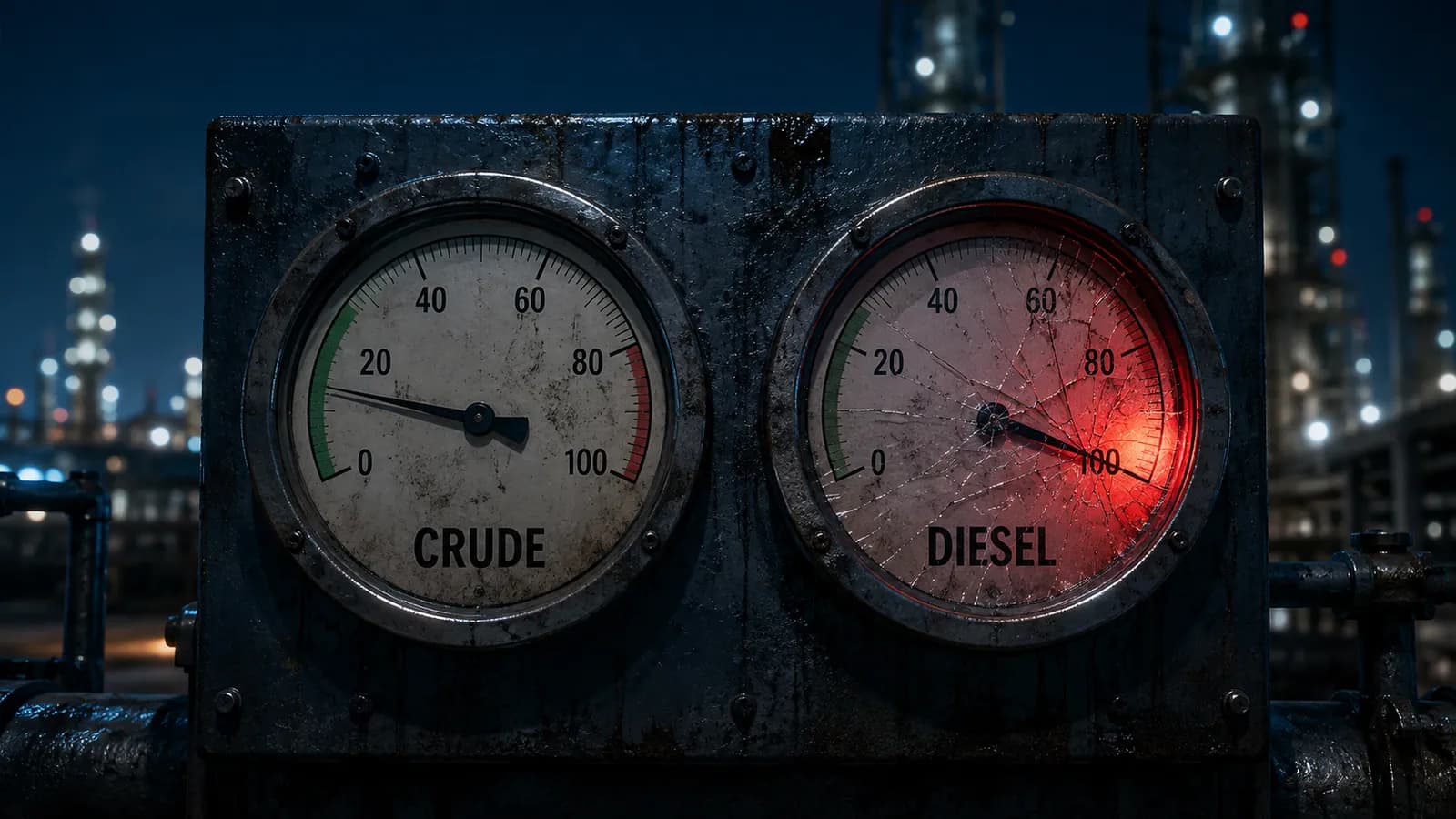
Everyone watches the Brent chart. The Brent chart is the wrong gauge.
Five months into the Hormuz crisis — the phase that began when the ceasefire collapsed and the blockade returned — something strange has happened. Crude oil, the commodity this crisis was supposed to be about, is behaving almost calmly. Brent trades in the low nineties, WTI in the mid eighties. Meanwhile, one story deeper in the value chain, records are being shattered. On August 17, the US diesel crack spread settled above $102 per barrel. That is the first triple-digit refining margin in history, in a market where $15 to $25 is the normal range.
One crisis. Two markets. And the gap between them is where this phase of the war is actually being fought.
Crude is flowing again, just not the way you think
Start with the surprising part: crude really is moving through the Strait of Hormuz. Not a trickle, either. According to maritime intelligence firm Windward, crude exports through the strait climbed from 1.6 million barrels per day in May to around 4 million in June and roughly 5 million in July. US officials put the total even higher, claiming a seven-day average approaching 9 million barrels per day, above most independent estimates. Before the war, the strait carried around 20 million barrels of crude and products daily.
How is this possible in a contested waterway? Because the traffic has gone invisible. Shipping analytics firm Kpler estimates that about 80 percent of Hormuz transits now run "dark": tankers switch off their AIS transponders, the tracking system that normally broadcasts a ship's position, and hug the Omani coast, as far from Iran as physically possible. The US military escorts them through a southern corridor, with 15 to 20 tankers slipping in and out each night. Gulf producers have added a shuttle system on top: chartered vessels carry crude through the strait, then transfer the cargo ship-to-ship to tankers waiting safely in the Gulf of Oman.

It works, but it is expensive and fragile. Iran has set up its own Persian Gulf Strait Authority to collect passage fees of up to $2 million per tanker, roughly a dollar per barrel. The United States has sanctioned that authority, which means any shipowner who pays Iran risks American sanctions. War-risk insurance and freight premiums stack on top. And the flow can collapse without warning: earlier this week, after Iran blacklisted 45 tankers for violating its passage rules, just two vessels transited the strait in a single day, the lowest count since early May.
So yes, crude flows. Quietly, at a premium, under military protection. That is why crude prices have stayed relatively contained.
Products are a different war
Now look at refined products, and the picture inverts completely.
Kpler data show Persian Gulf diesel exports down about 80 percent year over year, against a 48 percent decline for crude. The reason is brutally simple economics. TotalEnergies CEO Patrick Pouyanné put numbers on it at the ONS conference in Stavanger this week: moving a VLCC through Hormuz and back costs about $20 million. Divided by 2 million barrels of crude, that is an extra $10 per barrel, painful but workable. Product tankers are far smaller, so the same transit maths produces a surcharge of roughly $50 per barrel, which no diesel cargo can absorb. Crude sails. Product tankers stay put. Pouyanné says not a single product tanker is currently moving out of Hormuz.
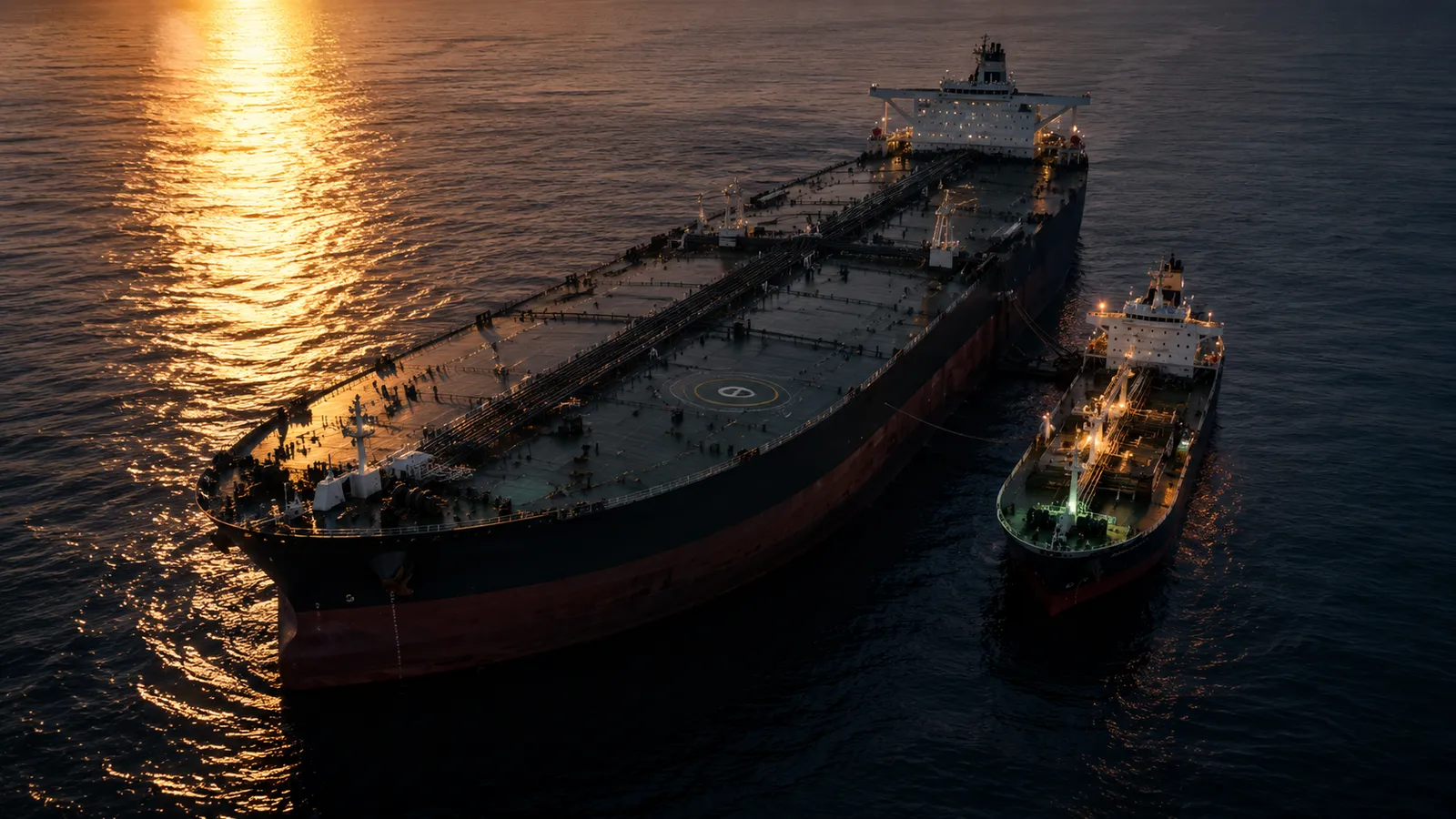
That freight split is the same disruption we mapped in the Trade Watch tanker edition: crude ships still sail, product tankers do not.
He captured the resulting paradox in one line, calling it a "very strange" market: bearish on crude, very bullish on products.
And Hormuz is only one of the fronts. Bank of America notes that three of the world's four major refining hubs are now impaired at once. Middle Eastern refining and export capacity is constrained by the strait and by reported strikes on facilities such as Saudi Arabia's Jazan complex. Russian refining has been hit by record Ukrainian drone damage, and Moscow has responded by banning diesel exports altogether. Drone strikes have also taken Libyan capacity offline. That leaves the United States as the only fully operational major refining center on the planet, drawing down its own inventories to feed a global scramble for fuel.
For the companies collecting that windfall, see who is profiting from the split.
The consequences are visible everywhere in the data. Citi estimates global observable diesel inventories have fallen below the five-year minimum. The International Energy Agency now projects a global supply deficit of 1.8 million barrels per day this quarter, more than double its previous estimate.
Why refiners elsewhere cannot close the gap
The mechanism behind the split is straightforward once you see it. When Gulf refineries are offline or their products cannot exit through Hormuz, their own demand for crude feedstock falls. That softens crude prices at the margin. But refineries in Europe, Asia and the Americas cannot absorb the lost product volume one for one. Utilization was already high before the crisis, new refining capacity takes years to build, and the plants that do have spare room are already running flat out and shifting yields toward diesel.
Strategic reserves make the distortion worse, not better. Government crude releases suppress the crude price, but you cannot pour crude into a fuel tank. The US Strategic Petroleum Reserve has now dropped below 300 million barrels, while the downstream shortage it was meant to ease continues untouched. Every barrel released widens the visible gap between calm crude and panicked products.
The better thermometer
This is why the price at the pump can bite far harder than the Brent chart suggests, and why headlines announcing "oil prices ease" can coincide with diesel getting more expensive by the week.
If you want to know how much stress this crisis is putting on the real economy, stop watching the flat price and start watching the crack spread: the margin between a barrel of crude and the products refined from it. Diesel cracks at four to six times their normal level are telling you that the bottleneck of this war is not at the wellhead. It is at the refinery gate and on the product tanker that refuses to sail.
Crude measures the fear. Products measure the damage.
Sources
Facts below are from the cited outlets. Interpretation of the split between crude and products is HormuzEye analysis.
- Reuters, US diesel crack surpasses $100 a barrel for first time as supply disruptions hit (17 August 2026)
- Zawya / Reuters, TotalEnergies CEO Patrick Pouyanné on moving discounted oil through Hormuz (ONS Stavanger, 24 August 2026)
- Investing.com, Oil trading in August 2026: backwardation, crack spreads and Hormuz risk explained
- CNBC, Iran war: Strait of Hormuz ship traffic and oil flows (Windward, 18 August 2026)
- Gulf News, 80% of Hormuz traffic goes dark and keeps oil prices in check (Kpler)
- Axios, Hormuz oil corridor: 15–20 tankers slipping through each night (19 August 2026)
- CNN, Strait of Hormuz shipping data: Persian Gulf Strait Authority fees and US sanctions
- Baird Maritime, Strait of Hormuz tanker traffic thins out to just two vessels
Disclaimer: HormuzEye provides educational and informational market analysis only. This content is not financial advice, not investment advice, and not a buy or sell recommendation. Oil markets are volatile and geopolitical events can change quickly. Always do your own research and consult a qualified financial adviser before making investment decisions.