
Educational market analysis only. Not financial advice.
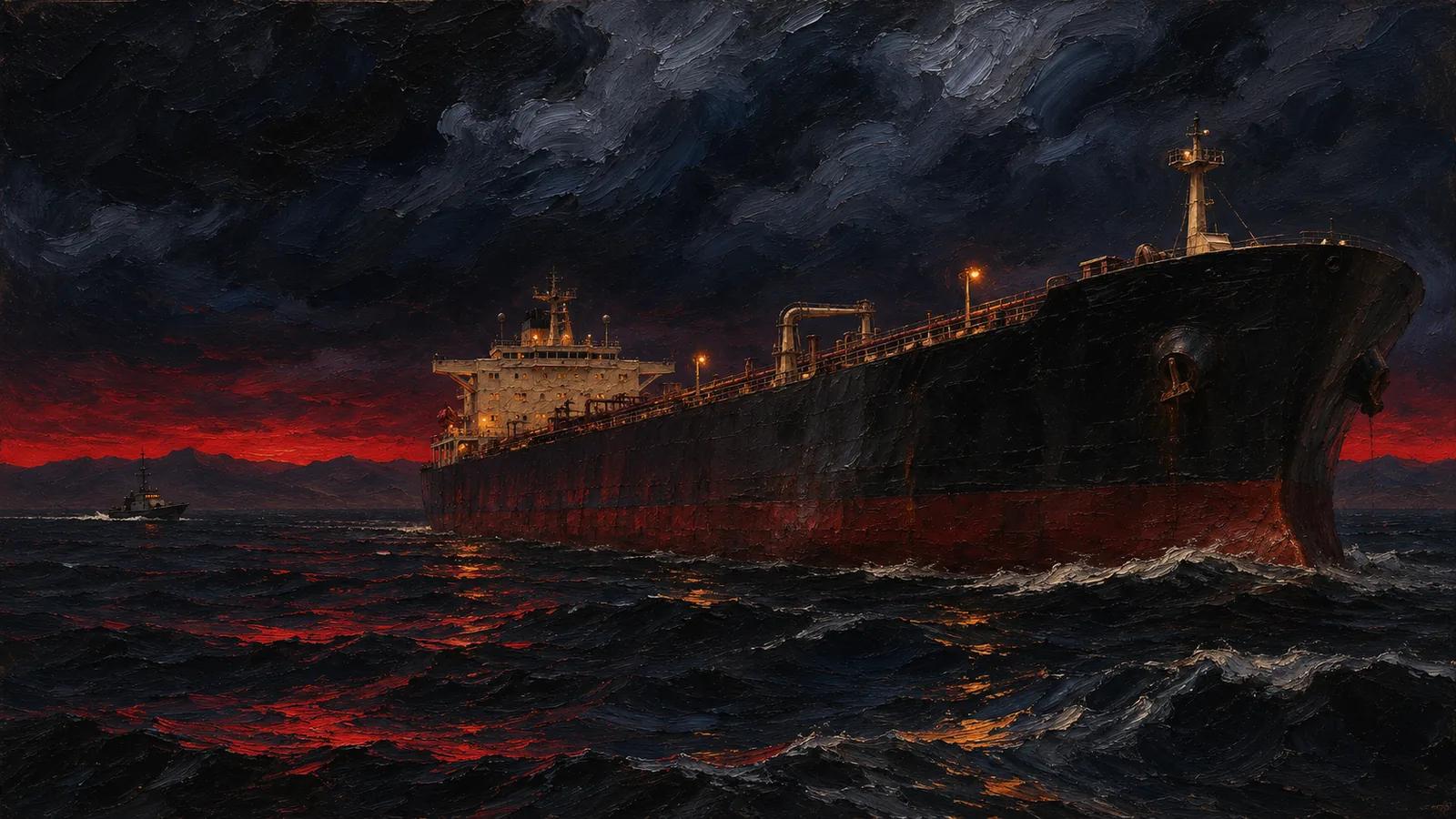
Saturday evening, a US aircraft fired on a cargo ship in the Gulf of Oman. Minutes later, Iran's Islamic Revolutionary Guard Corps (IRGC) said two tankers had hit mines in the Strait of Hormuz. Some outlets called it a first: both sides striking merchant ships on the same day.
It sounded like a turning point. We nearly read it that way ourselves.
It wasn't. The United States has fired on ships trying to run its blockade of Iranian ports since April. A Hellfire missile into the engine room of the Lian Star in May. Two more into the Vela Nova in August. A fighter jet strike on a cargo ship on 10 October. Saturday was the latest entry in a long and grim routine.
So that headline is not why we raised the score. We moved it from 94 to 95 because of two other things.
What changed
First, the United States is striking Iran again. Before the midterm elections on 3 November, US forces hit Qeshm Island, the large island inside the Strait. On Saturday, Trump confirmed new strikes near the Strait. That evening, Iranian media reported explosions on Qeshm and in the port of Jask. The cause is not yet clear.
Second, Iran has removed a ceiling it set for itself. The IRGC says it has lifted its 2,000 kilometre limit on the range of its ballistic missiles. That limit was a signal of restraint. Removing it is a signal too.
What didn't change
Some tankers still get through, as our last weekly report showed. But not many. Our transit tracker shows about three ships a day. Before the war, the figure was around 85.
Attacks continue at October's pace. The UK Maritime Trade Operations agency (UKMTO) counted 35 vessels hit in October, the most of any month in this war. It logged at least five more incidents in the first days of November.
One word of caution. Many of this week's mine claims come only from Iranian state media. No maritime authority has confirmed them. We count what we can verify, and the UKMTO figures make the point on their own.
Why the score stays below the top
Diplomacy is not dead. On Friday, Trump spoke with Qatar's Emir about Doha's push for a comprehensive agreement to end the war. Oman says it is still working with Iran on a joint system to control the Strait.
Washington also has a fresh reason to want out. Vice President JD Vance blamed the war for the Republican losses in the midterms. Wars that cost elections tend to get shorter.
And Iran is letting some ships through. On 3 November, an Iranian lawmaker said vessels from India, China, Iraq and Qatar are exempt from its restrictions.
But an exemption is not a guarantee. Pakistan believed it had a safe passage arrangement of its own. Then a tanker carrying liquefied natural gas to Pakistan was attacked.
Tehran's public line is hard as well. Senior Iranian official Mohsen Rezaei says the Strait stays closed and there will be no talks with Washington until Iran's seven conditions are met.
What the market is saying
Brent dropped below $100 after the midterms, as traders bet on a quicker end to the war. It closed Friday just under $98.
That is a market pricing hope. Our score measures what is happening on the water. Right now, those are not the same thing.
What moves the score next
Up to 97: a direct naval clash between the United States and Iran, a strike on Gulf oil infrastructure, or Iranian missiles fired beyond the old 2,000 kilometre range.
Back to 92: a signed framework through Qatar, or a working Iran-Oman shipping corridor with transits back above ten a day.
Not every loud headline is a step up the ladder. This week, the quiet ones mattered more.
Sources
- ABC News, 8 November: Iran, Strait of Hormuz update: explosions and talks.
- Reuters via US News, 5 November: Tankers hit in Hormuz as Iran keeps up pressure after the US vote.
- NewsNation, 6 November: Oil tankers and mines in the Strait of Hormuz.
- IranWire, 3 November: Iran exempts India, China, Iraq and Qatar from Strait restrictions.
- Nikkei Asia, 8 November: Pakistan's Hormuz agreement faces a test after an LNG tanker attack.
- Task & Purpose, May 2026: US Hellfire missile and the blockade in the Gulf of Oman.
- Al Jazeera, 11 August: US military fires on a cargo vessel said to be breaking the Iran blockade.
- Oman Observer, 11 October: Report dated 11 October on a strike against a cargo ship.
- straits.live, 5 November: Daily brief, 5 November 2026.
- straits.live, 6 November: Daily brief, 6 November 2026.
Disclaimer: HormuzEye provides educational and informational market analysis only. This content is not financial advice, not investment advice, and not a buy or sell recommendation. Oil markets are volatile and geopolitical events can change quickly. Always do your own research and consult a qualified financial adviser before making investment decisions.