

Educational market analysis only. Not financial advice.
If you follow oil, you did not miss July. When the June memorandum between Washington and Tehran collapsed and strikes returned to the Gulf, crude rose roughly 16 percent in a single week — about 30 percent above its early-July lows — with one session alone adding close to 10 percent. Within minutes of the first headlines, the pattern repeated itself everywhere: trading chats lit up, #OOTT filled with charts, and thousands of traders asked themselves the same question at the same moment. Should I be in this?
It is an understandable question. It is also, in our view, the wrong one — because it smuggles in an assumption that quietly destroys returns: the assumption that seeing the news fast gives you an edge. In oil markets, it almost never does. This edition of Trade Watch looks at why speed is the worst edge in oil — and what actually works instead.
The Illusion of the Head Start
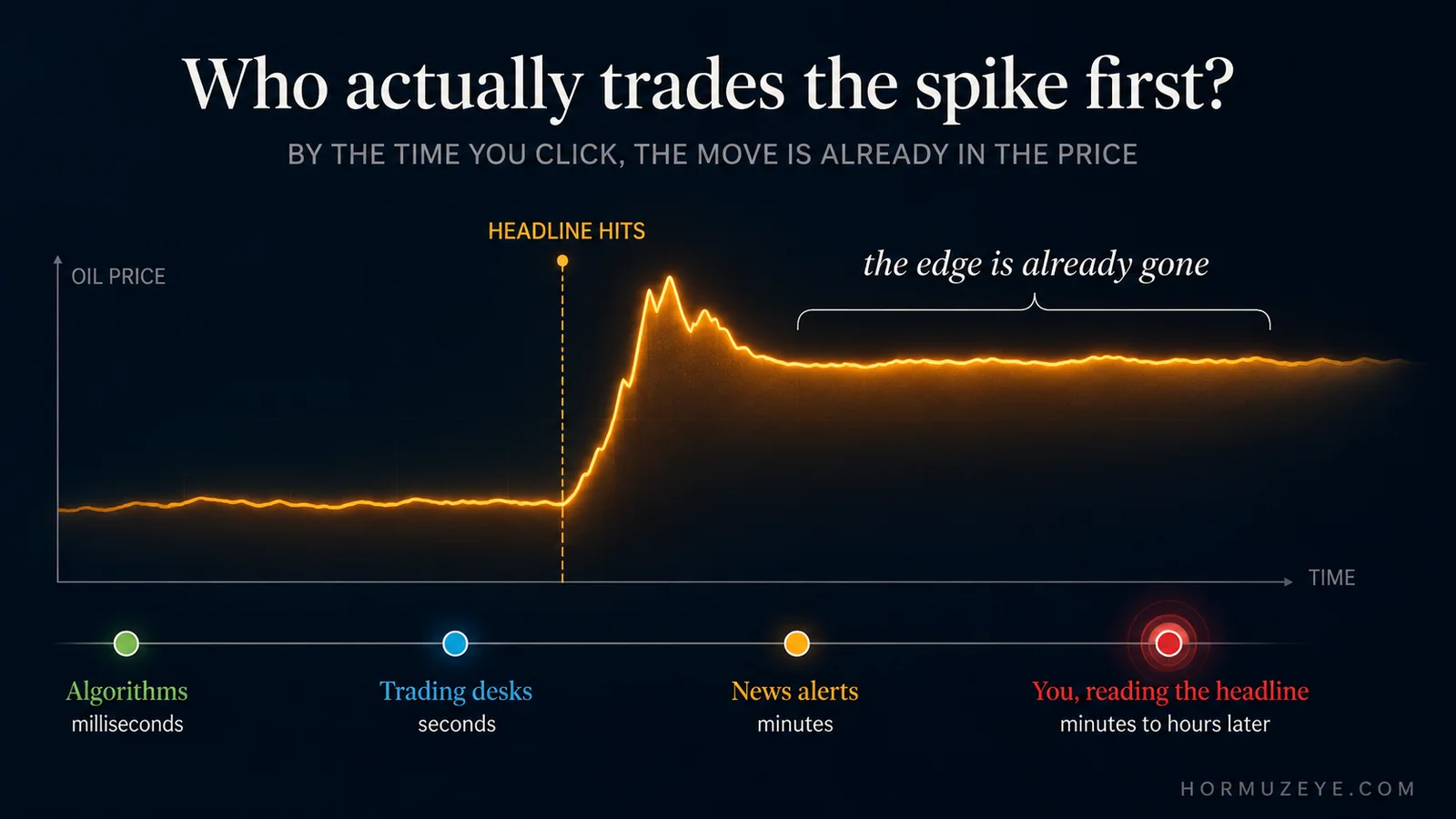
Here is the uncomfortable arithmetic of a geopolitical headline. By the time a Hormuz escalation reaches your screen — whether via Reuters, a push notification, or a fast account on X — it has already passed through the wire services, the algorithmic news readers, and the professional desks that pay for microsecond feeds precisely so that no one sees it before they do. The repricing you are looking at is their reaction. Crude routinely moves within seconds of a headline; on the biggest days of July, much of the day's range was established before most of Europe had finished reading the first paragraph.
This means the feeling of being early is systematically misleading. You are not ahead of the market; you are the market — arriving together with everyone else who reads the same free sources at the same speed, but carrying the emotional conviction of a scoop. Acting on that conviction usually means buying the top of a freshly priced-in risk premium: paying today for fear the market absorbed an hour ago. The information was real. The head start was not.
Fast Brains, Slow Barrels
Behavioral economics has a name for what happens next. Daniel Kahneman's distinction between two modes of thought — a fast, intuitive, pattern-matching system and a slow, deliberate, analytical one — maps almost perfectly onto headline trading. Urgency activates the fast system: it recognizes a shape ("this looks like 2019 — oil went up"), attaches an emotion, and demands action. The slow system, the one that asks how many physical barrels are actually at risk, what was already priced in, and what the second-order effects might be, needs something the moment refuses to give it: time.
The problem is that oil, more than most markets, is a slow-system market wearing a fast-system costume. Prices jump on sentiment within seconds, but the questions that determine where prices settle — tanker transits, pipeline bypass capacity, strategic reserve policy, the diplomatic calendar — resolve over days and weeks. Trading the jump with the fast brain means competing where you are weakest, on the terrain where the machines are strongest.
The Urge to Do Something
There is a second bias stacked on top, and it is arguably more dangerous: action bias. Knowing something creates an almost physical urge to do something with it. A moving price feels like a train leaving the station; standing still feels like a decision, and an expensive one. Fear of missing out does the rest — especially in oil spikes, where the moves are large, the narrative is dramatic, and social media is full of people who appear to have caught the bottom.
But in fast markets, doing nothing is frequently the correct trade, and it is the one the fast brain finds hardest to make. What separates experienced market participants is rarely faster reaction; it is a higher tolerance for deliberately not reacting. They have internalized something the headline-chaser has not: the market does not reward participation. It rewards being right about what happens next — and on a spike day, "what happens next" is precisely the thing nobody has had time to think through yet.

Deeper, Not Faster
So what is the alternative? Not better speed — better questions. When Hormuz makes headlines, the fast question is "how do I get in?" The deep questions are the ones that take an afternoon rather than a second.
What was already priced in? A risk premium is not a fact about barrels; it is a probability estimate embedded in the price. If the market was already carrying a substantial Hormuz premium before the headline, much of the "news" may be old fear wearing a new date.
What are the second-order effects? First reactions price the disruption; second reactions price the response — strategic reserve releases, pipeline rerouting, demand destruction at higher prices, the diplomatic incentives that a spike itself creates. The first move is often loud and wrong; the second is quiet and decisive.
What is structural and what is noise? Tanker transits through the strait, insurance rates, physical export volumes — these are signals. A minister's afternoon soundbite, retracted by evening, is not. The discipline is refusing to let the loudest input be the most weighted one. Even on some of July's most violent days, roughly 8.5 million barrels still transited Hormuz in a single day, according to the U.S. Department of Energy — a physical fact that contradicted the panic long before the price did.
This is scenario thinking rather than prediction — and it is the entire reason this platform exists. We hold the view, stated plainly on our About page, that no one can consistently predict the price of oil. But mapping the scenarios, their rough probabilities, and what each would mean is not prediction. It is preparation — and preparation is what turns a spike from a temptation into information.
How Professionals Approach a Spike
None of this is trading advice — we do not give any, ever. But it is worth describing how experienced market participants tend to behave on days like the ones July delivered, because the pattern is consistent. They act on plans made before the headline, not after it. Position sizes are set in calm markets, precisely so that volatile ones cannot dictate them. A spike triggers a review of scenarios, not a search for an entry. And the first hours after a shock are treated as the least informative of the entire episode — maximum noise, minimum signal — which is exactly when the untrained instinct screams that they matter most.
Notice what all of this has in common: none of it is fast. The professional edge in oil is not reaction time. It is having done the slow thinking early, so that when the fast moment arrives, there is nothing left to decide in a panic.
The Real Edge
The July spike will not be the last. As long as a fifth of the world's oil moves through a strait that geopolitics can close in an afternoon, headlines will keep arriving, prices will keep jumping, and the urge to chase will keep firing on schedule. The traders who are hurt by those days are rarely the ones who lacked information. They are the ones who mistook speed for insight.
Our answer, for whatever it is worth, is the one we built HormuzEye around: we will never be first, and we are not trying to be. We would rather spend the hours the market spends panicking on the questions that decide where it settles. Speed is everywhere and worth nothing. Understanding is scarce — and it compounds.
Sources
Facts below are from the cited institutions. Interpretation of market behavior and trading psychology is HormuzEye analysis.
- Daniel Kahneman — Thinking, Fast and Slow (System 1 / System 2)
- U.S. Energy Information Administration (EIA) — World Oil Transit Chokepoints (Strait of Hormuz ~20% of global petroleum liquids consumption)
- U.S. Energy Information Administration (EIA) — Petroleum spot price data (July 2026 price moves)
- U.S. Department of Energy via CNBC — Hormuz transit volumes during the July 2026 hostilities (~8.5 million barrels in a single day)
- AP — Oil prices drop after Trump orders US forces to hold off on new strikes (August 2026)
- Bloomberg via Yahoo Finance — Oil slumps as Trump holds off Iran attack (August 2026)
- CNBC — Oil prices fall as Trump says he called off planned strike on Iran (August 3, 2026)
Disclaimer: HormuzEye provides educational and informational market analysis only. This content is not financial advice, not investment advice, and not a buy or sell recommendation. Oil markets are volatile and geopolitical events can change quickly. Always do your own research and consult a qualified financial adviser before making investment decisions.