

Educational market analysis only. Not financial advice.
Last updated: Wednesday 19 August 2026
A commercial vessel has been struck by an unknown projectile while sailing outbound through the Strait of Hormuz. The impact damaged the engine room. One crew member was killed, according to media reports citing the UK Maritime Trade Operations centre, and the Omani Coast Guard assisted the remaining crew.
The attack came within hours of U.S. President Donald Trump declaring the Strait of Hormuz "open and operating," saying mines in the waterway had been cleared or detonated. Trump also said no talks with Iran are taking place or scheduled, while the U.S. naval blockade remains in force.
Iran presents a very different picture. Tehran maintains the strait is closed until Washington meets its conditions.
The gap between those two positions is increasingly visible in the shipping data. And this latest attack exposes something more uncomfortable than either government wants to admit.
The attack happened on the protected route
This is the detail that matters most.
According to the Joint Maritime Information Center, the vessel was sailing southbound less than one nautical mile from the Omani coast when it was hit. That is the southern corridor. It is the route where the U.S. military assists transiting vessels.
In other words, the attack did not happen to a ship taking its chances in contested waters. It happened inside the escorted lane that is supposed to demonstrate the strait is functioning again.
If the protected route is not safe, no route is. For shipowners, charterers and insurers, that single fact carries more weight than any official statement about the waterway being open.
Traffic remains a fraction of normal
Kpler tracking data show that only six commodity vessels crossed the Strait of Hormuz on Monday. That followed just three crossings on Saturday and two on Sunday.
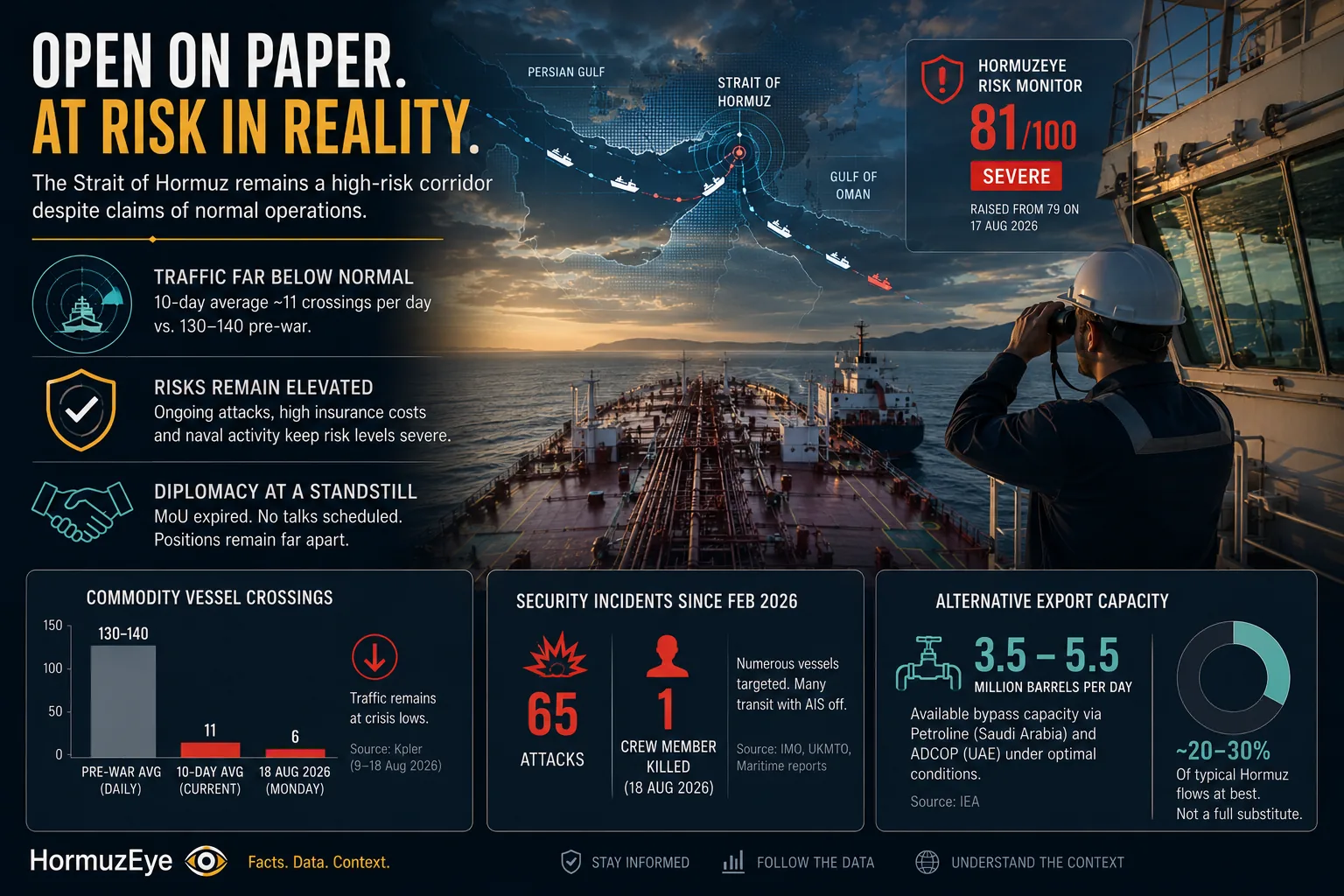
The recent 10-day average stands at approximately 11 vessels per day. Before the conflict began in late February, roughly 130 to 140 ships typically crossed the strait each day.
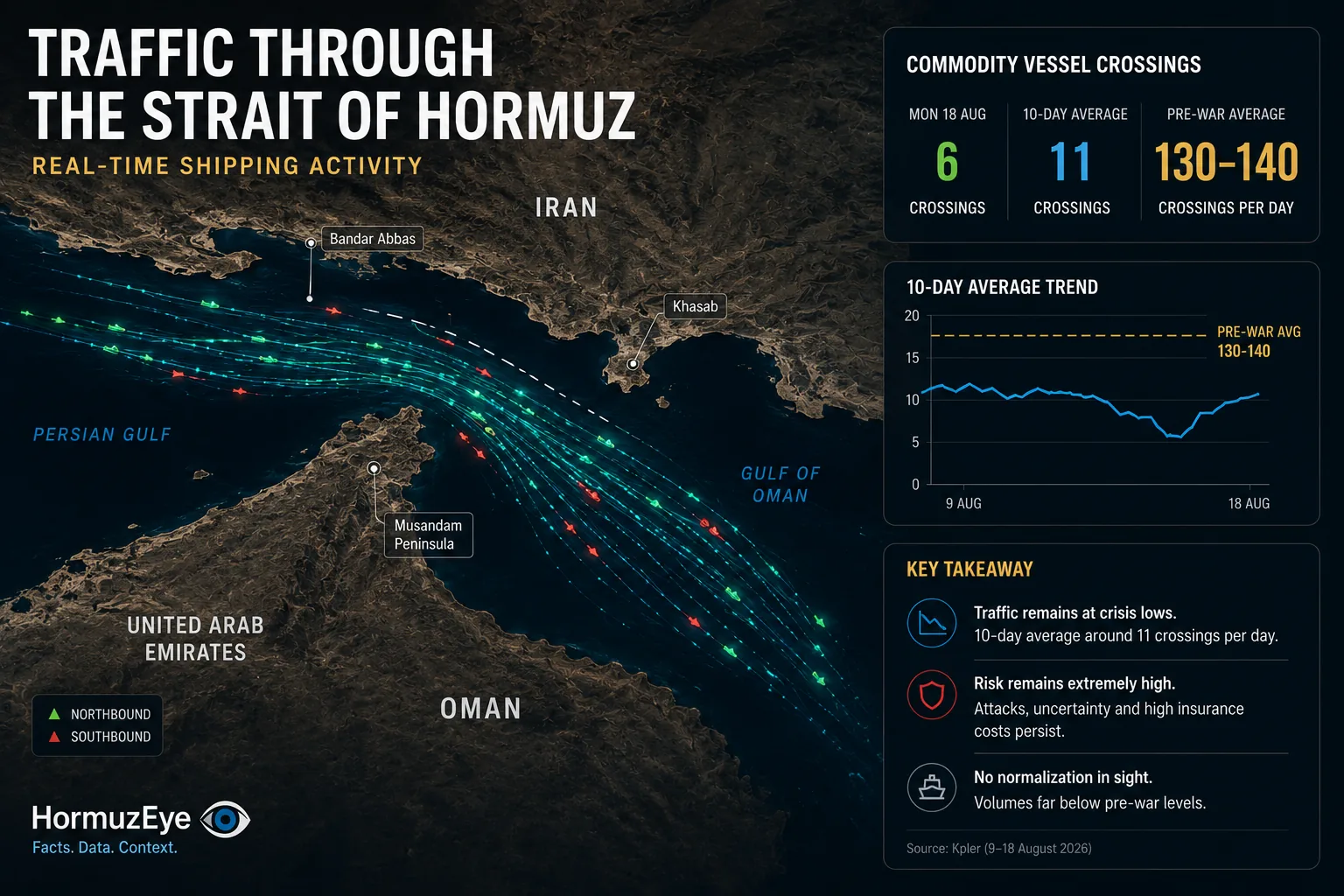
No VLCCs or LNG carriers were recorded among Monday's crossings, although the data cannot capture every movement because some vessels continue to transit with AIS switched off.
Translated into barrels, the picture is just as stark. The U.S. Energy Information Administration estimates that crude oil and petroleum liquids moving through the strait averaged just 4.9 million barrels per day in the second quarter. In the fourth quarter of 2025, before the war, that figure was 21.6 million barrels per day.
The distinction matters. A waterway can technically be open while remaining commercially impaired. For shipowners, charterers and insurers, the relevant question is not simply whether a vessel can pass through Hormuz. It is whether that passage can be made safely, predictably and at an economically acceptable level of risk.
At present, the traffic data suggest that confidence remains extremely low.
Diplomacy remains unresolved
The latest attack also comes after the expiry of the 60-day window connected to the interim U.S.-Iran arrangement reached in June.
That arrangement deserves a brief recap, because it explains the current standoff. The U.S. and Iran signed a memorandum of understanding on 17 June to reopen Hormuz to commercial shipping. The deal collapsed almost immediately over routing. Iran demanded that vessels transit through its territorial waters. Washington insisted on the southern corridor under U.S. military protection. Iran attacked tankers using that corridor, and the U.S. responded with airstrikes and reimposed its naval blockade.
Today, Trump says there are no negotiations taking place and none scheduled. Iran maintains that the strait will remain closed until Washington fulfils conditions connected to the earlier agreement, including measures relating to the blockade, sanctions, frozen Iranian assets and military operations.
At the same time, Iran and Oman have been discussing arrangements concerning navigation through the strait. That has created another source of tension. Trump has publicly threatened military action against Oman if it obstructs U.S. objectives in the region, and analysts point to visible frustration in Washington that Muscat is coordinating with Tehran rather than leaving the reopening effort to the Americans.
The result is a widening gap between the positions of Washington and Tehran, with Oman increasingly caught between them.
Why is oil not at $120?
Brent crude settled at $90.87 on Monday and traded around $91 on Tuesday as expectations for a rapid diplomatic breakthrough faded.
Which raises an obvious question. If Hormuz traffic has collapsed by more than 90 percent, why is oil not far higher?
Three factors are holding the price down.
China has stepped back from the market. Chinese imports have been cut by an estimated 4 to 5 million barrels per day since the war began. Analysts see this as the single biggest reason crude has not surged further. If Beijing allows its refiners to ramp imports back up, that cap disappears.
Demand destruction is doing part of the work. The International Energy Agency describes a feedback loop in which the same supply shock that supports crude prices also suppresses the demand needed to sustain them, through elevated fuel prices and disrupted supply chains. OPEC, notably, sees far less demand destruction. That disagreement leaves the market with two very different paths for the remainder of 2026.
The market is trading headlines, not barrels. Since April, Brent has reacted more strongly to negotiation rumours than to the actual flow picture. Kpler currently sees a range-bound market with $110 as the ceiling, contingent on China staying out of the buying.
Alternative export infrastructure provides the Gulf with some resilience, but it cannot fully replace the strait. Saudi Arabia's East-West pipeline and the UAE's Abu Dhabi Crude Oil Pipeline allow some crude to bypass Hormuz, with an estimated 3.5 to 5.5 million barrels per day of alternative capacity under favourable conditions. That is significant. It is not a substitute for normal Hormuz operations.
"Open" does not mean normal
This is the central distinction.
Trump can describe the Strait of Hormuz as open while ships continue to cross it. Iran can simultaneously describe the waterway as closed while allowing or tolerating selected traffic. Neither description, by itself, tells us whether Hormuz is functioning normally.
The operational evidence provides a clearer picture:
6 commodity crossings on Monday.
10-day average: approximately 11 per day.
Pre-war level: approximately 130 to 140 per day.
Throughput: 4.9 million barrels per day in Q2, against 21.6 million before the war.
Add a fatal attack on the protected southern route, elevated war-risk insurance costs, vessels operating without AIS, and unexplained oil residue now washing up on the Iranian coast at Qeshm Island, and the picture is not one of normalisation. It is one of severely constrained navigation.
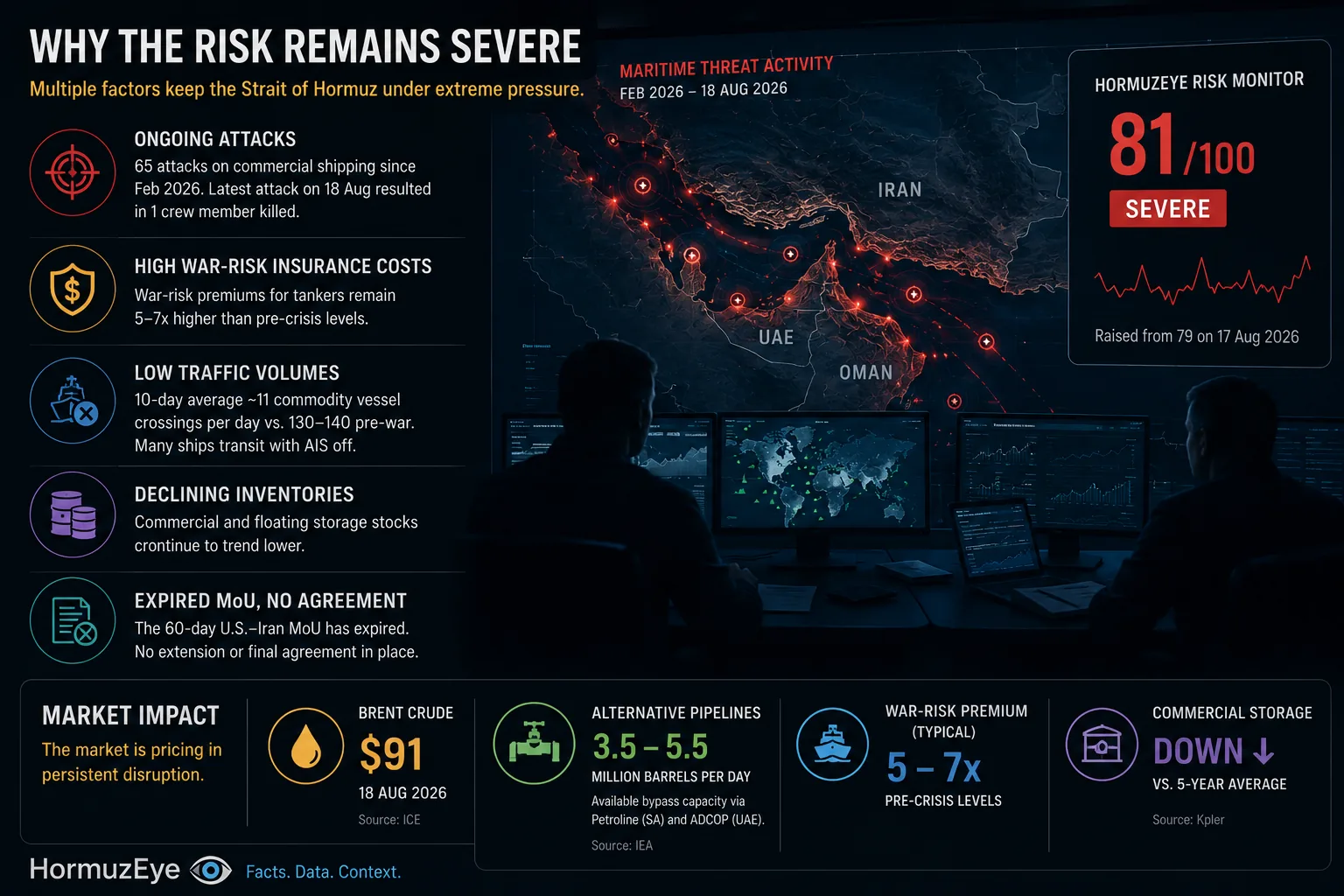
HormuzEye currently maintains its Hormuz Risk Monitor at 81/100, Severe.
The important question for energy markets is therefore not whether the Strait of Hormuz is technically "open." It is whether traffic volumes, security, insurability and predictability are returning.
For now, the data say they are not.
That reading has not aged out. In September, tracked Strait of Hormuz shipping fell again after US and Iranian strikes on tankers. See Hormuz Is Open. Shipping Has Already Collapsed.
Frequently asked questions
Is the Strait of Hormuz open or closed?
Both and neither. Ships are physically transiting, so the strait is not sealed. But traffic is running at less than 10 percent of pre-war levels, vessels on the U.S.-protected route are still being attacked, and Iran says the waterway remains closed until its conditions are met. Open in name, severely constrained in practice.
How many ships are crossing the Strait of Hormuz right now?
Kpler data recorded six commodity vessel crossings on Monday, with a 10-day average of roughly 11 per day. Before the war began in late February, the strait saw around 130 to 140 crossings daily. Some vessels transit with AIS switched off, so tracked counts understate total movement.
Why are oil prices not higher if Hormuz traffic has collapsed?
Three reasons. China has cut imports by an estimated 4 to 5 million barrels per day, removing the marginal buyer. High fuel prices are destroying demand, which the IEA says feeds back into weaker consumption. And alternative pipelines through Saudi Arabia and the UAE carry a meaningful share of Gulf exports around the strait. Brent trades around $91, well above pre-war levels but below what a full supply shock would imply.
Disclaimer: HormuzEye provides educational and informational market analysis only. This content is not financial advice, not investment advice, and not a buy or sell recommendation. Oil markets are volatile and geopolitical events can change quickly. Always do your own research and consult a qualified financial adviser before making investment decisions.