
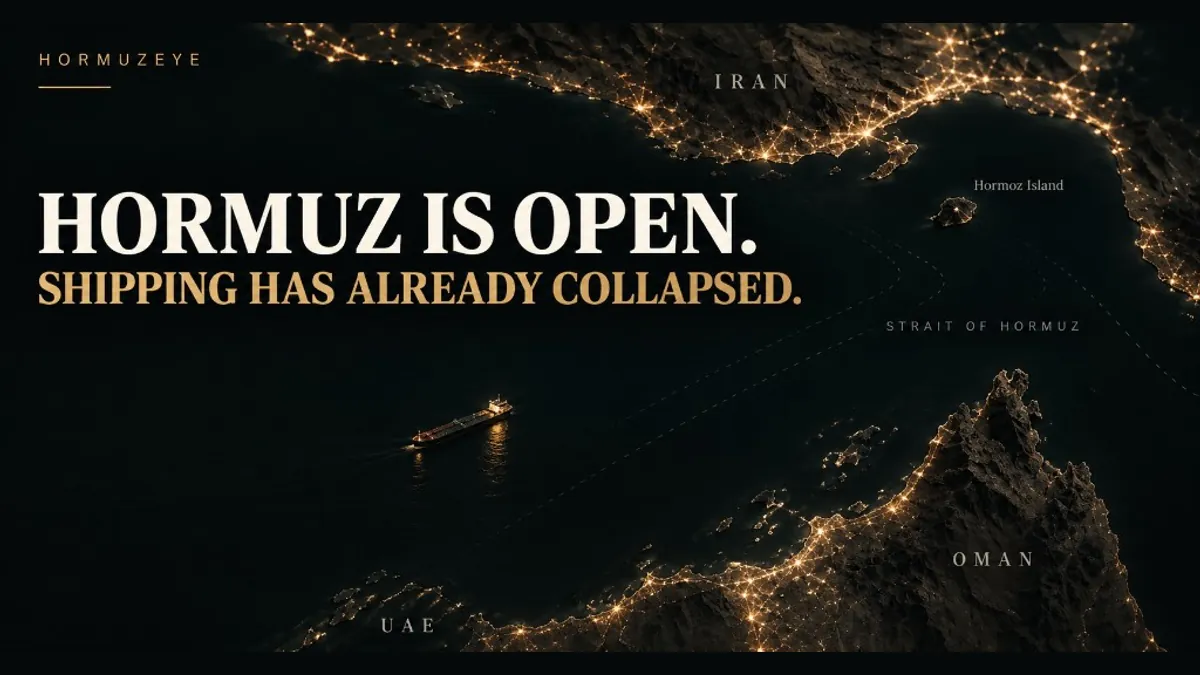
Educational market analysis only. Not financial advice.
Last updated: Tuesday 8 September 2026
The Strait of Hormuz does not have to be sealed to disrupt the oil market. It only has to become a place that most commercial ships will not treat as a normal voyage.
On 7 September, a senior United States official told Al Jazeera that the waterway is fully open, under US Navy control, and that Washington is satisfied with current oil and gas flows through it.
On that same day, Kpler tracking cited by Reuters showed a 10-day average of 10 commodity vessels a day through the strait, the lowest since May. Two ships crossed on Saturday. Six crossed on Sunday, mostly on the Iranian route.
Both statements are defensible. They are answers to different questions. This analysis is about the gap between them, because that gap is where the oil market actually lives.
Hormuz is open, on paper
Four statements can be true at the same time. Markets often treat them as one.
Legal or formal closure would mean a declared, durable shutdown of the strait as an international waterway. That is not the current fact pattern, though the legal layer is no longer static, and we return to that below. Physical accessibility means a hull can still pass through the channel. Commercially viable transit means owners, charterers, insurers and crews will accept the voyage as a repeatable business decision. Functional disruption is what happens when the last of those conditions fails even if the first two still hold.
US officials describe the strait as open and operating. Iran describes it as closed until its conditions are met. Neither position is a substitute for vessel counts, casualty reports, insurance terms or export volumes.
The useful question is not whether a ship can physically squeeze through. It is whether enough tankers will do so, on terms the oil market can rely on.
Shipping has already collapsed
Before the conflict, tracked commodity traffic through Hormuz ran at roughly 130 vessels a day on Kpler's count. That is the baseline HormuzEye has used throughout this crisis, including in the August update that first recorded the traffic collapse.
A note on that number, because it decides how every other figure reads. Pre-war baselines for Hormuz vary widely by source, from roughly 85 to 178 vessels a day, depending on whether the count includes all shipping, commodity vessels only, or laden tankers only. HormuzEye uses the Kpler commodity-vessel series consistently so that week-on-week comparisons stay valid. Readers comparing our figures with other trackers should check which series they are reading.
Against that yardstick, a 10-day average of 10 ships is not a dip. It is transit volume at under a tenth of normal.
The weekly print says the same thing from a different angle. Kpler counted 77 vessels through the strait last week, down 28 percent on the week before. The direction of travel is not stabilisation.
The daily sequence matters too. Two commodity vessels on Saturday. Six on Sunday. Reuters, citing Kpler, reported that Sunday's inbound traffic included one very large crude carrier and three bulk carriers laden with metals, grains or oilseeds. It also reported that no VLCC had exited the strait since Wednesday.
A tanker carrying refined products loaded from a Saudi port attempted to leave and was turned back, according to LSEG data cited in the same Reuters report. An entry is not an export. A U-turn is not a functioning products market.
One caution belongs next to every AIS-based count. Some cargoes still move with transponders switched off. Tracked totals therefore understate total physical movement. HormuzEye treats that as a measurement problem, not as proof that commercial shipping has recovered. If the visible, insurable, AIS-on market has fallen to a fraction of normal, the strait is not operating as a global oil artery.
The lagged flow data point the same way. In its August Short-Term Energy Outlook, the US Energy Information Administration estimated that crude oil and petroleum liquids through Hormuz averaged 4.9 million barrels a day in the second quarter, down from 21.6 million in the fourth quarter of 2025. That is not a September snapshot. It is independent confirmation that the collapse in traffic has already rewritten the physical balance.
Why tankers are staying away
The commercial decision is not mysterious. It is a stack of risks that no single escort statement can cancel.
Security incidents remain frequent. Reuters, citing UKMTO's weekly report, said there had been 27 projectile-strike incidents since 6 July, with damage to vessels in and around the strait. Earlier in September, UKMTO reported an inbound tanker struck by an unknown projectile about 12 nautical miles north of Khasab, Oman. Separate reporting described two tankers hit near the Omani coast on 1 September. Confirmed damage and reported incidents are not the same thing. Both raise the cost of saying yes to a voyage.
Military activity has moved back onto commercial hulls. On 5 September, US Central Command said IRGC ballistic missiles were launched toward two US Navy warships, an aircraft carrier and a guided-missile destroyer, which evaded the attacks with no US personnel harmed. CENTCOM said US forces then permanently disabled the Iranian crude carriers M/T Downy off Kharg Island and M/T Stark 1 near Jask, and destroyed the unladen M/T Kylo, also known as Noxen, in the Gulf of Oman after the crew was directed to abandon ship. CENTCOM commander Admiral Brad Cooper framed the strikes explicitly as economic punishment, saying that two US ships fired on would be answered by taking out three Iranian ones. Iran's IRGC navy said it had targeted three oil tankers travelling unauthorised routes in the strait and three additional US vessels elsewhere. Iran's parliament speaker Mohammad Bagher Ghalibaf then declared that the era of proportionate responses was over.
Merchant shipping is no longer collateral in this exchange. It is the currency of it. That is the single most important change since August, and it is what a charterer is now pricing.
Insurance follows the threat picture, not the press conference. Before the war, hull war-risk rates for Hormuz transits were reported at roughly 0.15 to 0.25 percent of vessel value. By late July, Marsh was quoting 7.5 to 10 percent, which Lloyd's List reported as implying more than $10 million for a single VLCC trip. Those are the most recent firm figures in the public domain, and they predate the September strikes by six weeks. HormuzEye has not seen a verified September print. Treat 7.5 to 10 percent as a floor rather than a current quote, and note that price is only half the question. Deductibles, listed-area terms and sanctions clauses decide whether a voyage is commercially viable at all.
Crew safety is not a soft variable. On 31 August a Saudi-flagged tanker was attacked in the strait. Two Filipino sailors were killed. Oman's Maritime Security Center said the Royal Navy of Oman evacuated 16 of the 25 crew and provided medical support. Officers and ratings can refuse a passage. Manning agencies and flag states price the same projectile risk that underwriters do. A legally open strait with an unacceptable human-risk profile is still a closed strait for the ships that will not sail it.
Route uncertainty compounds the rest. Iran has channelled traffic onto corridors it controls, while the United States has promoted a southern, escorted lane closer to Oman. Advisories have described hails directing AIS-on vessels toward the northern Iranian-controlled route, and Iran has targeted ships it says used unauthorised tracks. Shipowners then face a second legal problem: paying a passage fee to an Iranian authority can create US sanctions exposure. Meanwhile CENTCOM said on 7 September that it has redirected 94 commercial ships accused of violating the US blockade of Iranian ports, disabled three and boarded two. Compliance is not a single decision. It is a choice among contested and mutually exclusive rule sets, each enforced by a party with weapons.
Commercial risk management does the last piece of work. Charterers, traders, P&I clubs and cargo interests do not need a blockade declaration. They need a repeatable, insurable, crewable voyage. When that disappears, tanker traffic collapses even while the water remains wet.
The legal layer is being rewritten, not held
The claim that there has been no formal closure is accurate. It is also becoming the least interesting thing about the legal picture, because three separate regimes are now being built on top of a strait that formally has one.
On 7 September, Mohsen Rezaei, head of Iran's Supreme National Security Council, said Tehran will announce a maritime exclusion zone beginning at the line of the US naval blockade, extending toward the strait and continuing into the Persian Gulf. Few boundary details have been published, and it is not yet clear what inclusion on Iran's list would mean for a vessel entering the zone.
The Persian Gulf Strait Authority, meanwhile, operates a regime for non-compliant vessels that threatens fines, detention or confiscation, and extends exposure to ships conducting ship-to-ship transfers with designated vessels.
Running against both, Iran's foreign ministry said on 7 September that talks with Oman had reached their final stage and that an understanding on a temporary safe route through the strait would be registered with the International Maritime Organization within days. Rezaei said maps of a new corridor lying in Iranian and Omani waters, under Iranian management, had been agreed and were due to be signed.
That last item is the only development this week that points toward normalisation, and it should not be buried. A registered corridor is a step toward predictability, and predictability is what insurers price. But note what it does not do. It does not remove the transit fee question that Washington rejects, it does not resolve five Gulf states' standing objection to Iranian management of waters they consider their own, and it does not make a corridor safe merely by giving it a number.
For a shipowner, the practical effect of all three regimes together is a fourth cost layer that sits on top of war risk, freight and delay: legal exposure that cannot be hedged, because complying with one authority means defying another.
Iran does not need to formally close Hormuz
A formal closure is a political and legal event. Functional disruption is an economic one.
If attacks, military signalling, corridor rules, insurance cost and crew refusal cut transits to a small fraction of normal, the oil-market effect can begin to resemble a partial closure. Fewer barrels leave the Gulf, more production is shut in, more weight falls on pipelines that cannot replace the strait, and the risk premium thickens.
That is the strategic logic. Tehran does not have to announce that Hormuz is closed if enough commercial actors already treat it as too costly to use. Washington does not make the strait commercially normal by declaring it open.
HormuzEye's working distinction is therefore simple. Open answers a navigational question. Usable answers a market question. The second is the one that moves oil.
Why oil has not exploded even further
If tracked traffic is running at under a tenth of the pre-war commodity baseline, why is crude not in a full-shock range? Brent touched $99 a barrel on Tuesday morning, a seven-week high, after rising around 8 percent over the previous week, with WTI above $92. That is elevated and climbing. It is still short of the $120 scenarios some banks attach to a broader, lasting cutoff. That gap is not proof that disruption is fake. It is evidence that buffers and demand are still absorbing part of the blow.
Several of those buffers are real. None of them is a substitute for a normal strait, and at least one of them is now under attack.
Pipelines carry part of the load. Saudi Arabia can move crude west through the East-West pipeline to Yanbu on the Red Sea. The UAE can load at Fujairah through the Habshan to Fujairah line, which reporting through the crisis has placed at or near its roughly 1.8 million barrel-a-day capacity. Saudi Aramco's Hormuz-crisis playbook is built on exactly this kind of bypass. It is material. It is also capacity-constrained, and it does not restore Kuwaiti, Qatari, Iraqi or most Iranian seaborne exports.
The main bypass is now itself a target. EIA data show Bab el-Mandeb oil volumes rising from 5.4 million barrels a day in late 2025 to 8.1 million in the second quarter of 2026 as Saudi barrels were rerouted. That redundancy is eroding as this is published. Houthi forces have launched a broad offensive toward territory bordering Bab al-Mandab, with more than 300 dead in days of fighting on the Red Sea coast. On 8 September a Riyadh-led coalition said Houthi strikes on Saudi Arabia wounded 73 people, with Houthi media claiming hits on Abha International Airport, King Khalid air base and Aramco facilities at Abha and Jizan.
This deserves more weight than it is getting in most coverage. A chokepoint crisis is survivable while the alternative route holds. Hormuz and Bab al-Mandab under simultaneous pressure is a different problem, because the second route was the reason the first one's closure remained priceable. Redundancy failing is not additive risk. It is multiplicative.
Inventories have already been spent. EIA's August outlook described large global inventory draws and estimated Middle East production shut-ins averaging 5.5 million barrels a day in July, with Hormuz shipments assumed to remain severely constrained through August. Strategic stocks can delay a price spike. They cannot rebuild a shipping lane, and every barrel drawn is one that is not available next quarter.
Weaker demand is doing some of the work. High fuel prices destroy consumption at the margin. In the United States, regular gasoline averaged $4.15 a gallon this week, close to a dollar above last year and a record for the Labor Day period. Some buyers have cut or delayed purchases rather than bid for every remaining Gulf cargo. Non-OPEC supply outside the Gulf, in the United States, Brazil, Guyana and elsewhere, still exists. None of that puts 20 million barrels a day of Hormuz-normal oil back into the water.
Residual flows still move. Escorted southern transits, dark AIS-off cargoes, and whatever Iran-linked tonnage continues to run the northern route. Those barrels explain why the market has not treated the strait as a total cutoff. They do not show that commercial shipping has recovered.
Market expectations do the rest. Traders price the next diplomatic headline and the next attack as much as they price today's two-ship Saturday. OPEC+ participants meeting on 6 September kept October required production unchanged rather than announcing an emergency surge. That is consistent with a market that is disrupted but not one that has found a new, comfortable equilibrium.
Risk Monitor: raised to 92
HormuzEye's Risk Monitor moves from 89 to 92 out of 100 with this analysis. It remains in the Severe band.
Three things drove the increase. Threat became loss: the late-August score reflected escalation risk, while the record now includes a Saudi-flagged tanker attacked with two crew killed, three Iranian tankers destroyed, and merchant hulls used deliberately as instruments of reciprocal pressure. Transit volume fell rather than stabilised, to a 10-day average of 10 vessels and a weekly count down 28 percent. And the Bab al-Mandab bypass, which had been absorbing rerouted Saudi barrels, came under direct attack.
One factor argued against a larger increase. The Iran and Oman corridor is due for registration with the IMO within days, and formalisation of any transit regime moves the system marginally toward predictability.
What would take the score to 95: physical interdiction on both Hormuz and Bab al-Mandab in the same week, a strike on onshore export or production infrastructure, or a verified war-risk quote above the July range combined with withdrawal of cover by a major underwriter.
What would bring it back to 85: the Iran and Oman corridor registered and used by non-Iran-linked tonnage, VLCC exits resuming as routine, and two consecutive weeks without an attack on a merchant vessel.
The score is a synthesis, not a leading indicator. Vessel counts and insurance terms will tell you sooner than the monitor will whether September's dip is a blip or a new floor.
What matters next
The next useful question is not "is Hormuz open?" It is which of these gauges is moving.
- Daily commodity vessel crossings, not speeches
- Tanker-specific traffic, especially VLCC entries versus exits
- Whether the Iran and Oman corridor is actually registered with the IMO, and whether anyone outside Iran-linked tonnage uses it
- The boundaries and enforcement of Iran's announced exclusion zone, once published
- Attacks on merchant shipping, including projectiles on escorted routes
- War-risk additional premiums and whether cover remains available on commercial terms
- Pipeline and Red Sea and Fujairah utilisation, and whether Bab al-Mandab holds
- Brent's response to each traffic print and each strike
- Military posture around Kharg, the Gulf of Oman and US-escorted shipping
Bottom line
The Strait of Hormuz can remain technically open while becoming commercially close to unusable.
That is not a claim that the waterway has been legally closed. It is a reading of the traffic, the attack record, the insurance market and the lagging EIA flow data. Formal closure is one way to create a global energy disruption. Functional disruption is another, and it is already here.
What would change this view? A sustained recovery in daily crossings, VLCC exits resuming as a routine event, war-risk premiums falling back toward peacetime, and a single set of corridor rules that owners and insurers will actually use. Until those appear together, "open" remains a geographic description, not a market one.
Six months later, that inventory and bypass buffer is itself under strain. See why the Hormuz energy crisis is entering a more dangerous phase, as pressure spreads into alternative routes, inventories and refined fuels.
Sources
Facts below are from the cited outlets. The distinction between legal openness, physical access, commercial viability and functional disruption is HormuzEye analysis, as is the Risk Monitor score and its thresholds.
- Reuters, Hormuz traffic dips to lowest since May after US, Iranian strikes on ships (7 September 2026)
- Al Jazeera, Hormuz shipping traffic falls sharply as US insists waterway fully open (7 September 2026)
- Al Jazeera, Can Iran enforce a restricted zone in the Strait of Hormuz? (7 September 2026)
- CBS News, live updates on the Iran war, Hormuz and oil prices (8 September 2026)
- US Central Command / DVIDS, CENTCOM destroys 3 IRGC oil tankers after Iran targets 2 US Navy warships (5 September 2026)
- US Energy Information Administration, Short-Term Energy Outlook, global oil and Hormuz flows (11 August 2026)
- UKMTO via Shipping Telegraph, tanker struck by unknown projectile near Oman's Khasab (1 September 2026)
- The New York Times, two more oil tankers are attacked in the Strait of Hormuz (1 September 2026)
- Insurance Business, Hormuz war-risk rates face fresh pressure as Iran-US clashes resume
- Lloyd's List, Hormuz war risk cover tops $10m for single VLCC trip (27 July 2026)
- Reuters via The Business Times, OPEC+ keeps oil output policy unchanged for October (6 September 2026)
Disclaimer: HormuzEye provides educational and informational market analysis only. This content is not financial advice, not investment advice, and not a buy or sell recommendation. Oil markets are volatile and geopolitical events can change quickly. Always do your own research and consult a qualified financial adviser before making investment decisions.