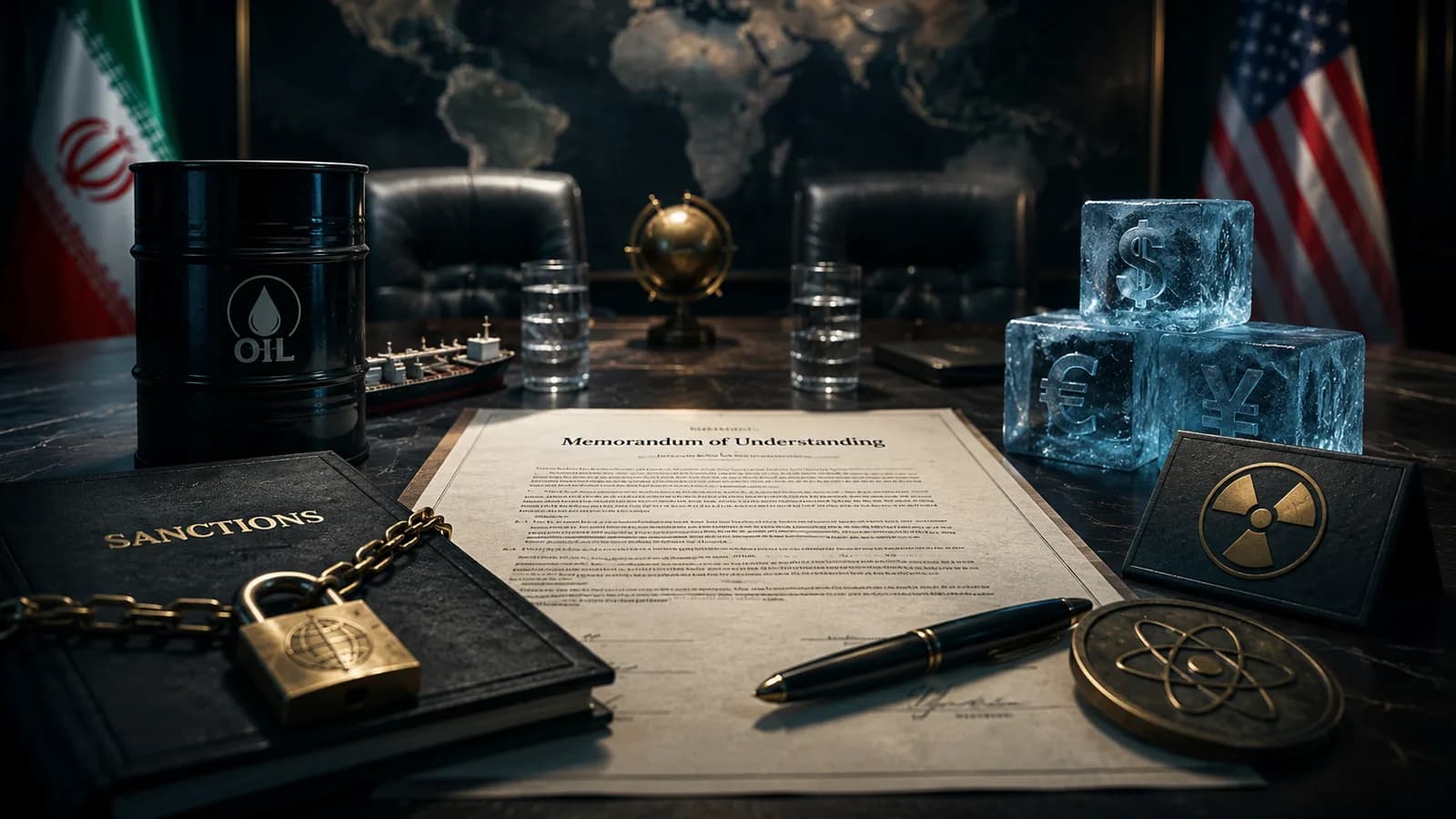
For four days the market traded a deal nobody had read. On 17 June that changed: Washington released the official text of the 14-point memorandum, the "Islamabad Memorandum of Understanding", after public pressure that the language had stayed hidden. The document is due to be signed in person in Switzerland on 19 June. You might expect a published text to settle the argument. It does close to the opposite.
The officials who wrote it are already talking it down. The US side describes it as a "political document" that does not capture the real, back-channel commitments, especially on the nuclear file, while the Vice President called it roughly a page and a half of general language. And buried in the text is a detail most headlines missed: the toll-free passage through the Strait of Hormuz that this whole rally rests on lasts 60 days. Not permanently - sixty days. That is a direct contradiction of the "permanently toll free" reopening the President announced when the framework broke.
That gap, between the announcement and the document, is the story for anyone trading crude. Markets have already pulled most of the Hormuz war premium out of the price on the assumption that the strait reopens and stays open. The official text shows how much of that is still an assumption.
This piece breaks down what is actually in the MoU, what is genuinely contested, and what it means for the oil price between now and the autumn.
What's actually agreed, and what isn't
Mediators (Pakistan and Qatar) announced the framework on 14 June. The document was signed electronically in mid-June by President Trump, Vice President Vance and Iran's parliamentary speaker, Mohammad Bagher Ghalibaf, with the formal in-person ceremony set for 19 June at the Bürgenstock resort above Lake Lucerne. The points both sides broadly accept are the de-escalation clauses:
- An immediate and permanent end to the war on all fronts, including Lebanon, with a mutual pledge not to use force again.
- Mutual respect for sovereignty and no interference in each other's internal affairs.
- A 60-day window (extendable) to negotiate a final agreement covering the nuclear file and remaining sanctions.
- A final deal to be locked in through a binding UN Security Council resolution.
Where it gets slippery is everything that actually moves oil. The official US text and the earlier Iranian draft (circulated through state outlet Mehr) overlap but differ on the points that matter, and US officials insist neither fully captures the private understandings. Three differences stand out:
- Hormuz is toll-free for 60 days only. The official text grants commercial vessels passage at no charge for sixty days, a time-limited window, not the permanent free transit that was announced. What happens on day 61, tolls, inspections, "Iranian arrangements", is left open.
- The nuclear language is firmer than the draft. The official version adds a "minimum methodology" for neutralising Iran's near-bomb-grade uranium: down-blending it with lower-grade material under IAEA supervision. That is more concrete than the vague nuclear language in the leaked draft.
- It is explicitly performance-based. A senior US official framed it as an arrangement where Iran earns relief only by complying, no nuclear weapon, neutralised uranium, no disruption of Hormuz navigation. The Iranian narrative, by contrast, still has sanctions waivers, the release of roughly $24 billion in frozen assets, and at least $300 billion in reconstruction financing arriving up front.
So the structure both sides accept is a ceasefire and a clock. The substance that actually moves crude, the durability of an open strait, the sequencing of sanctions relief, the money, is precisely what remains unsettled, and the published text quietly confirms it.
How we got here
It is worth remembering how far the market has already travelled. The US- and Israeli-led war against Iran began on 28 February 2026. Within weeks the Strait of Hormuz, the chokepoint for roughly a quarter of seaborne oil and a fifth of global LNG, was effectively closed to "unfriendly" shipping, with the IRGC warning vessels off and laying what it described as mines. The US ran a naval blockade of Iranian ports from mid-April to late May. For the full context on how the closure played out through early June, see our Strait of Hormuz analysis from June 2026.
That June framework did not hold. For the eight days that killed the ceasefire and brought the blockade back, see Ceasefire Dead, Blockade Back.
For weekend traffic and SPR drawdowns as of mid-August, see the Hormuz Update of 11 August.
For the live Strait of Hormuz picture, see the status page.
The price response was violent. Brent pushed above $114 a barrel in March, with some dated benchmarks spiking toward $140 in the worst sessions; WTI broke $100. An April ceasefire that included Israel took the edge off, but the following weeks became a game of brinkmanship over access to the strait.
By 16 June, with the MoU in view, Brent fell another ~4% to around $80 - its lowest in three months and a fourth straight losing session. By 18 June, with the official text out, it had eased further toward $78. That is the move traders need to internalise: most of the war premium is already gone. The cheap part of this trade has happened.
What is the deal actually worth?
Honestly assessed, the MoU is a real achievement on one axis and close to empty on another.
On de-escalation, it delivers. A permanent ceasefire and a reopened shipping lane remove the tail risk that was keeping a double-digit premium in the oil price. For the global economy that is the part that matters most in the short term, and it is why equities and crude moved the way they did.
On resolution, it delivers very little. This is a truce with a timer, not a settlement, and the side that wrote it says so out loud. Calling your own agreement a "page and a half" "political document" is not the language of a binding settlement. The missile programme, Iran's regional proxies, and full nuclear verification are deferred to the 60-day talks. The single most consequential clause, point 14, makes the entire final agreement conditional on a sequence of steps being implemented first. In plain terms: nothing is binding until a lot of fragile things go right in order.
There is also a strategic reading that should temper any "America won" narrative. Iran has demonstrated it can close Hormuz and absorb a war. It now negotiates the final deal from a stronger position than it held before the conflict, arguably stronger than under the old JCPOA. Whatever gets signed in Switzerland, the market has learned that the strait is a weapon Tehran is willing to use, and that lesson does not un-learn. For the fuller ledger of what that shift means for Washington, see Art of the Deal? What America Actually Gained from the Iran War.
The uncertainties that will decide the oil price
Five things will determine whether the current price holds, falls further, or snaps back.
The 60-day toll cliff. This is the new one, and it is underpriced. Free passage is guaranteed for sixty days. The market is treating reopening as permanent, but the document is explicitly temporary. If charges, inspections, or "Iranian arrangements" reappear when the window closes, right as the final-deal talks are meant to conclude, the cost of moving a barrel through Hormuz becomes a live variable again. A toll is a soft re-imposition of risk without a single shot being fired.
Implementation of Hormuz. Reopening a waterway is not a press release. If mines were laid, they have to be cleared, and notably, the US military has not confirmed that Iran ever placed them, which makes the framing of a reopening "for mine removal" diplomatically convenient but operationally murky. Tankers return at scale only once war-risk insurance premiums fall, and underwriters move on evidence, not announcements. There is one early, tentative positive: tanker-tracking monitors reported the first Iranian crude exports in months leaving via Hormuz even before the formal signing, a sign that physical flows can resume, though a long way from full normalisation.
The nuclear and sanctions file. The 60-day talks have to turn the "minimum methodology" of down-blending into verified reality and settle the sequencing of sanctions relief, the exact issues the two sides are already contradicting each other on. Verification disputes are how deals like this historically unravel.
Israel. Tel Aviv is absent from the public terms and struck Lebanon the same weekend the framework was finalised, drawing criticism from both Iran and Trump. A single serious Israeli operation could collapse the ceasefire clause that the whole price move depends on.
Domestic politics. Trump is sending the agreement to Congress for review, and hardliners in Tehran calling the terms a surrender both have incentives to break the sequence before it completes.
Oil: what's priced in, what isn't
The market has priced the announcement. It has not priced implementation, and that distinction is the trade.
What's already in the price: the collapse of the worst-case Hormuz scenario, expectation of returning Iranian barrels, and a general unwind of long positions built during the war. Supply-side tailwinds are stacking up underneath this, OPEC+ has been raising quotas, the UAE left the cartel and lifted output during the conflict, and China's depleted stockpiles are a natural buyer for restored Iranian flows. The US strategic reserve sitting at a 43-year low is the one bullish counterweight in that mix.
What's not in the price: the time lag and the cliff. Saudi Aramco's CEO has warned that if Hormuz stays disrupted past mid-June, the market does not fully normalise until 2027. Physical flow recovery is measured in weeks and months, tankers, insurance, port operations, not in the days it took prices to fall. And underneath any normalisation sits a structural Hormuz risk premium of roughly $5-10 a barrel. You can see it in the screen: Brent traded $65-70 before the war began; at ~$78 today it is still carrying close to ten dollars of "the strait can be weaponised", now demonstrated rather than theorised, and reinforced by a free-passage guarantee that expires in sixty days.
For the deeper mechanics of how that premium is built and unwound, see our companion analysis, Why Oil Prices Fell Sharply: Is the Hormuz Risk Premium Fading?.
Rough scenario bands
These are directional, not forecasts, frames for thinking about risk.
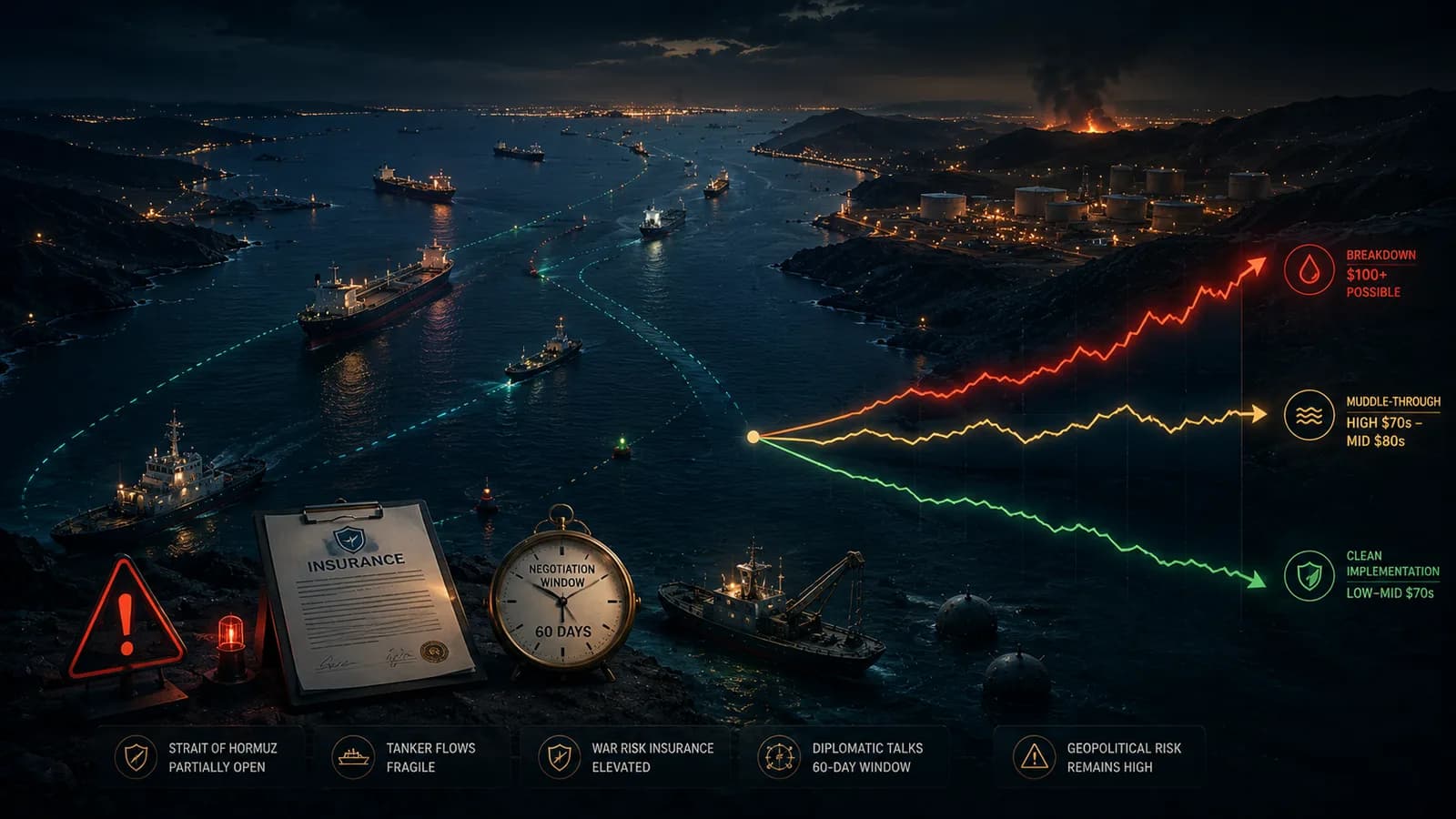
- Clean implementation (signing holds, tankers return, toll window rolls into permanent free transit, talks progress): Brent drifts into the low-to-mid $70s as the residual premium thins, floored by OPEC+ discipline and the demonstrated risk.
- Muddle-through (most likely): fragile stability in the high $70s to mid $80s, with sharp spikes on every headline out of Lebanon, the nuclear talks, or the approaching day-60 toll deadline.
- Breakdown (talks stall, an Israeli strike, proxies act independently, or the strait re-prices after the free window lapses): the premium reloads fast, a move back through $100 is plausible within sessions, because the market has shown in 2026 how quickly it reprices Hormuz.
The bottom line
The 14-point MoU is worth taking seriously as a circuit-breaker and worth discounting as a settlement. It buys time, reopens a vital artery, and justifies the unwind of crisis pricing that has already happened. It does not resolve the questions, sanctions, uranium, Israel, enforcement, that could put the premium right back in the price. And now that the text is public, it makes the case against itself: a free strait with a sixty-day expiry date, nuclear terms still to be verified, and authors who call their own document "political."
For traders the asymmetry is clear: most of the downside from peace is spent, while the upside from a breakdown is one headline, or one expired toll window, away. The cheap, easy part of this move is behind us. What's left is implementation risk, and that is not something you can sign in Switzerland.
For where the market actually settled once the ceasefire held and the strait reopened, see our follow-up, Oil After the Ceasefire: Where the Market Stands and What Comes Next.
This is analysis, not investment advice. Details around the MoU are contested and changing quickly; always cross-check official statements.