
Introduction
Oil prices fell sharply after the United States and Iran announced a deal to end the war and reopen the Strait of Hormuz. For traders, the move was not only about barrels, tankers or refinery demand. It was about fear being repriced.
When geopolitical risk rises, oil often moves before the physical supply data changes. Traders do not wait for a complete shutdown, a full reopening, or a final signed agreement. They price probabilities. If the probability of a worst-case scenario falls, part of the risk premium can disappear quickly.
That is what the market is doing now. With the worst-case Hormuz scenario suddenly looking far less likely, traders have pulled out a large part of the premium they had been paying for crude as protection against a wider crisis. But an announcement is not the same as an open, normalized waterway. The market is moving from crisis pricing toward conditional optimism.
The key question is simple: is the Hormuz risk premium genuinely fading, or is the market pricing a clean outcome before the hard part, implementation, has even begun?
What happened in the oil market?
Brent and WTI fell hard as traders reacted to the announcement of a deal between the United States and Iran, including the reopening of the Strait of Hormuz and the removal of the US naval blockade. President Trump declared the agreement "complete" and authorized the reopening of the Strait, while Iranian officials signalled agreement and a memorandum of understanding was reported to be moving toward signing.
The price reaction had already begun before the formal announcement. Crude had fallen roughly 12% from the middle of the previous week as a deal looked increasingly likely, with Brent dropping below the mid-$80s, its lowest level since early March. When markets reopened after the weekend, futures fell a further 4% on confirmation.
For the oil market, the logic is clear. If Hormuz is set to reopen and the blockade is lifted, the immediate risk of a severe, prolonged supply disruption falls sharply. That removes much of the premium traders had been paying for crude as insurance against a larger crisis.
But the first market reaction should not be confused with a final verdict. Oil prices move faster than diplomacy, faster than tanker schedules, and faster than physical supply chains. The screen can reprice in minutes. The real world takes longer. That gap between financial repricing and physical normalization is where the next phase of volatility may live.
Why the Strait of Hormuz matters
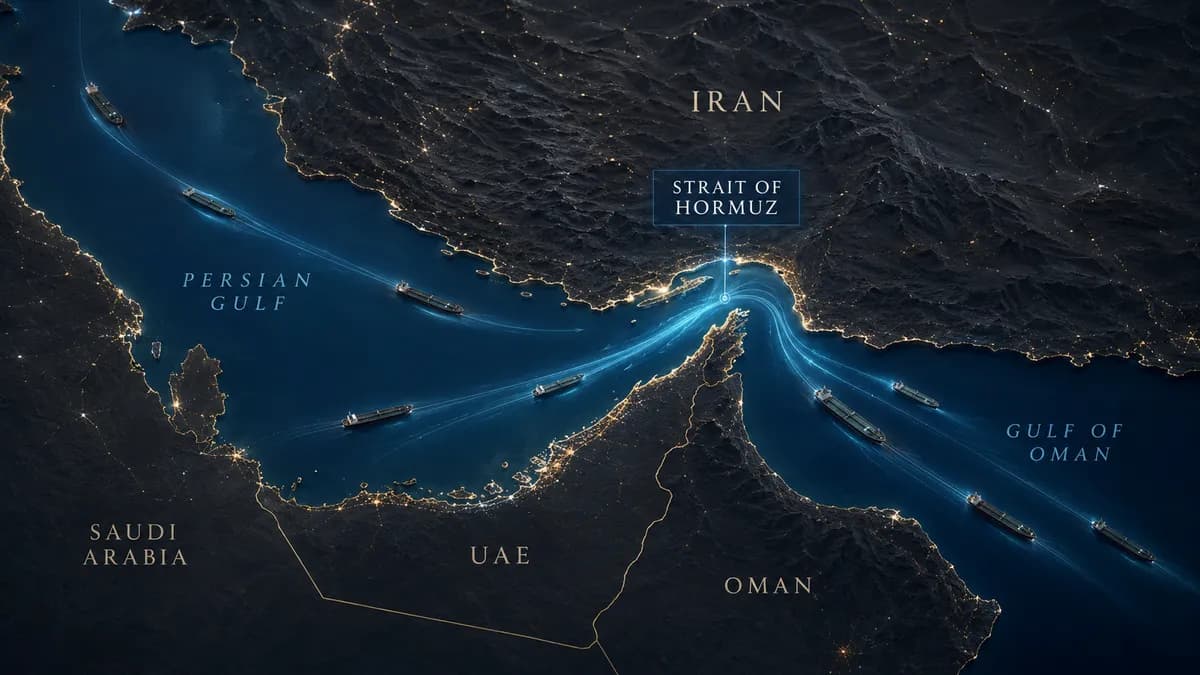
The Strait of Hormuz is one of the most important energy chokepoints in the world. It connects the Persian Gulf with the Gulf of Oman and the wider global shipping system. Before the war, roughly a fifth of the world's oil passed through or near this route, along with large volumes of condensates, petroleum products and liquefied natural gas.
When Hormuz is stable, the market treats it as part of the normal energy infrastructure. When Hormuz is threatened, as it has been since Iranian forces declared it "closed" earlier this year, the market prices a far more dangerous scenario: delayed cargoes, rerouted ships, higher insurance costs, naval risk, export uncertainty and possible shortages.
That is why a single headline about Hormuz can move oil prices immediately. The physical barrels may not have changed yet, but the perceived probability of disruption has. Oil is not priced only on today's supply. It is also priced on tomorrow's risk.
What is the Hormuz risk premium?
The Hormuz risk premium is the extra price traders are willing to pay for oil because of the possibility that supply could be disrupted around the Strait of Hormuz.
It is not one single number. It is a mix of different fears:
- the risk of military escalation;
- the risk of tanker attacks or delays;
- the cost of war-risk insurance;
- uncertainty around Gulf exports;
- possible sanctions changes;
- panic buying by physical buyers;
- speculative positioning by hedge funds;
- and the fear that a local crisis could become a global energy shock.
When those risks rise, oil prices can climb even before any major confirmed supply loss, as they did when Brent pushed above $110 at the height of the crisis. When those risks fade, prices can fall even before shipping has fully normalized, which is what is happening now.
This is why the current move matters. The market is not necessarily saying that everything is safe. It is saying that the worst-case scenario now looks far less likely than it did a week ago. That is a very different message.
With Brent back in the low $70s in July 2026, the gap between screen price and chokepoint physics has reopened, see Priced for Peace: What $73 Brent Gets Wrong About Hormuz.
Why oil prices fell
Oil prices fell because traders removed a large part of the fear premium that had built up around Hormuz over months of conflict.
During a crisis, the market prices in extreme scenarios before they happen. Traders ask: what if the Strait stays closed? What if tanker traffic does not recover? What if military escalation returns? What if Gulf exports remain constrained? What if insurance costs stay elevated?
The deal answers several of those questions at once, at least on paper. A reopened Strait, a lifted blockade, waived oil sanctions and the reported release of frozen Iranian assets all point toward de-escalation. So prices adjusted.
The fall is therefore not surprising. It reflects a classic geopolitical repricing. When fear enters the market, oil rises quickly. When fear fades, the risk premium can disappear just as quickly. But this repricing is still fragile. The market may be rewarding the announcement of de-escalation before it has evidence of full implementation. That is the central tension in this move.
The White House credibility question
There is another factor traders cannot ignore: credibility.
In normal conditions, a major White House declaration on war, sanctions or diplomatic progress would carry decisive weight. It still carries weight. But the past months have made traders more cautious about taking every political signal at face value.
The negotiation path to this deal was anything but linear: shifting deadlines, ultimatums, cancelled and renewed strikes, a two-week ceasefire, rejected plans and counter-proposals. A deal was repeatedly described as close, then stalled, then revived. Even the latest agreement was initially framed as “subject to finalization of documents.”
For oil traders, this is not simply a political issue. It is a pricing issue. A market can believe a deal is real and still apply a credibility discount to the announcement. Traders may buy the first relief signal, but they will want confirmation from the physical market before removing the full premium.
That confirmation will not come from a podium or a social-media post. It will come from tanker movements, insurance quotes, export data, port activity, mine-clearing operations, official statements and the behavior of physical buyers. In other words: the market may believe the direction of the announcement, but it may not yet fully believe the durability of the outcome.
Does the market really believe the deal?
The scale of the price fall suggests the market believes the probability of a severe Hormuz disruption has dropped significantly. But it does not necessarily mean the market believes in a clean, stable, fully implemented settlement.
Markets react in layers.
The first layer is headline reaction. A deal announcement, ceasefire language or reopening signal immediately reduces fear.
The second layer is confirmation. Traders then look for proof that the headline is becoming reality.
The third layer is normalization. Only when physical flows, insurance conditions and political behavior stabilize does the risk premium truly disappear.
Right now, the market is moving through the first layer and reaching for the second. The headline has been priced aggressively. The proof still needs to arrive. That is why oil may remain volatile even after a sharp fall. If the deal holds and the Strait genuinely reopens, prices could stabilize at lower levels. If implementation stalls, the market could quickly rebuild part of the Hormuz premium. The risk premium is fading. It has not vanished.
Why the risk is not gone
A completed announcement is not the same as full normalization.
Several risks remain.
First, implementation can slip. A deal can be declared before all parties finalize timing, sequencing, sanctions relief, asset transfers and security conditions, and a signed memorandum is only the start.
Second, the waterway itself must be made safe. Reopening Hormuz on paper does not clear mines, and shipping cannot return to normal until the route is physically secured.
Third, shipping confidence takes time to recover. Even with a formal reopening, tanker operators and insurers may wait for clear security guarantees before treating the route as routine.
Fourth, war-risk insurance may stay elevated. Insurance markets price not only current conditions but the probability of renewed escalation, and they tend to remain cautious after conflict.
Fifth, the physical market needs time to repair. Idled fields must be restarted, damaged energy facilities repaired, and cargo schedules rebuilt. As Saudi Aramco's leadership warned during the crisis, even an immediate reopening would take months to rebalance, and a delayed one could push normalization into 2027.
This is why the current drop should be read carefully. The paper market is repricing faster than the physical market can normalize.
What traders should watch next
The next phase will not be decided by the announcement. It will be decided by confirmation.
Traders should watch several signals closely:
- Brent and WTI behavior after the initial drop, stabilization or rebound;
- tanker movements through the Strait of Hormuz;
- mine-clearing and the lifting of the naval blockade in practice;
- war-risk insurance premiums;
- Gulf export volumes;
- official statements from Washington and Tehran, and the signing of the memorandum;
- reactions from Israel and Gulf states;
- OPEC+ language and potential output decisions;
- LNG traffic;
- the Brent-WTI spread;
- and whether physical buyers act as if the route is genuinely safe again.
The most important signal may not be political language. It may be shipping behavior. If tankers move normally, insurance costs fall and exports recover, the market will have stronger evidence that the Hormuz risk premium can keep fading. If shipping stays cautious, the price drop may prove premature.
What this means for the oil market
The fall in oil prices is logical. A lower probability of prolonged disruption means a lower geopolitical premium. But the move should not be mistaken for certainty.
Oil markets are forward-looking, but they are not always patient. They can remove risk quickly when headlines improve, then rebuild that same risk just as quickly if events disappoint.
For consumers, lower oil prices may ease inflation pressure. For central banks, the move may reduce some energy-related concerns. For producers, the fall trims revenue expectations after a period of elevated prices. For traders, the next question is whether this is the start of a durable repricing or a relief move that runs ahead of reality. The answer depends on whether the announcement becomes operational reality.
Conclusion
Oil prices fell sharply because the market reduced the Hormuz risk premium after the US and Iran announced a deal to end the war and reopen the Strait. That is a rational reaction to genuine de-escalation around one of the world's most important energy chokepoints.
But the market has not declared the risk over. It has declared the worst-case scenario far less likely. The announcement matters, but credibility matters too. After months of shifting timelines and abrupt reversals, traders may require more than a declaration before they remove the full premium.
The real test now is not whether oil fell on the news. It is whether mine-clearing, tanker traffic, insurance costs and physical export flows confirm the story. The Hormuz risk premium may be fading, but it has not vanished, and in oil markets, the difference between lower risk and no risk is where volatility lives.
For a full breakdown of the deal driving this move, see The Iran-US 14-Point Deal: What It's Really Worth for Oil.
Model a Hormuz disruption yourself and see the estimated price impact in our Hormuz Risk Monitor.
For the June 2026 analysis of this theme, see Oil Prices Are Falling, But the Strait of Hormuz Risk Has Not.
For weekend traffic and SPR drawdowns since June, see the Hormuz Update of 11 August.
For the live Strait of Hormuz picture, see the status page.
For an explicit investor scenario map, see Buy the Hormuz Shock, or Wait?.
HormuzEye provides market analysis and educational information only. This article is not investment advice. Oil prices and geopolitical risks can change quickly. Verify live market prices before making any decisions.
Sources
- NBC News / RFE/RL, US-Iran deal announced complete, Hormuz reopening authorized (June 14-15, 2026)
- RFE/RL / Reuters, MoU terms: Hormuz reopening, blockade lift, asset release, sanctions waiver (June 14, 2026)
- RFE/RL, Macron welcomes deal; UK-US maritime mission ready to support reopening (June 15, 2026)
- Trading Economics / NPR, crude down ~12%; Brent below ~$86.5; futures −4% on reopening (June 11-14, 2026)
- CNBC / Trading Economics, Brent peaked above $110-114 during crisis (Mar-May 2026)
- CNBC, Aramco CEO Nasser: reopening takes months to rebalance; delay pushes normalization into 2027 (May 12, 2026)
- NBC News, ~20% of world oil passed through Hormuz pre-war (June 2026)