
Introduction
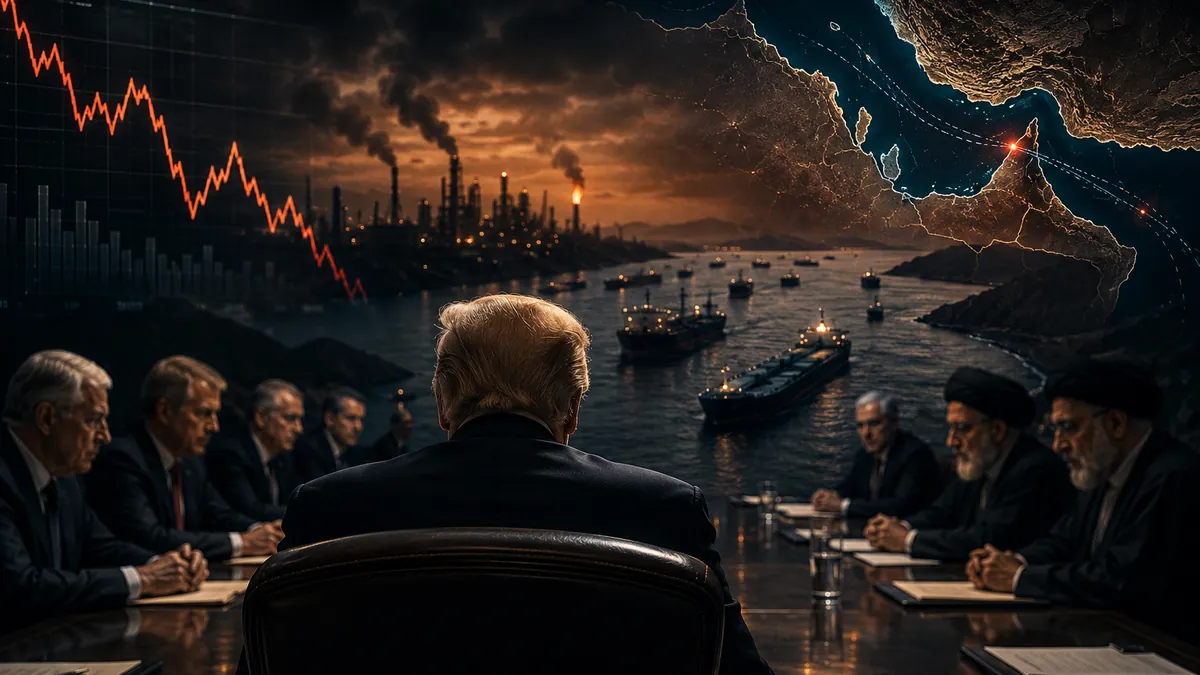
Washington and Tehran are talking again. A 60-day framework is on the table: the Strait of Hormuz reopens, the American blockade of Iranian ports is lifted, and sanctions waivers allow Iran to sell oil once more. Trump calls a deal achievable "within a week", even as he admits to deliberately stretching the talks to extract more concessions.
Time for the question that barely gets asked amid the geopolitical noise: what has America actually won after three and a half months of war? Compared with February 27, the day before the first strike, the answer is uncomfortably short. And Iran's position? On the point that matters most, it has not been weakened but strengthened. A sober ledger.
Four objectives, three months on
At the start of the operation on February 28, Washington set out four objectives: destroying Iran's ballistic missile capability, dismantling the Iranian navy, severing support for armed proxies, and guaranteeing that Iran would never obtain a nuclear weapon.
Three months later, the scorecard is thin. The Iranian navy has largely been neutralized, that objective was achieved. But that is where it ends.
The nuclear file, the official primary justification for the war, stands barely changed from February. Iran still holds an estimated 440 kilograms of uranium enriched to 60 percent, not weapons-grade (that requires 90 percent), but the point at which the final step can be taken relatively quickly. For completeness: a nuclear weapon requires more than uranium alone, design, detonation mechanism, miniaturization and a delivery system all play a role. But as a bargaining chip the stockpile counts in full, and that stockpile has not been destroyed, not handed over, and not placed under tightened supervision. Worse: Trump suggested in May that physically securing the uranium might "not be necessary", a remarkable retreat from the original war aims, duly noted by Iranian negotiators.
The missile program? Despite thirteen thousand targets struck, American media reported in May that Iran still holds substantial missile stockpiles. That is less surprising than it sounds: a large part of the arsenal, the Middle East's biggest before the war, sits in underground facilities, dispersed storage sites and mobile launch systems. Damage is not the same as elimination. And Iran does not need to keep everything to exert pressure; enough to make shipping, bases and energy infrastructure uncertain again will do. Oil, after all, does not trade on actual damage, oil trades on risk.
The proxies? Hezbollah fights on in Lebanon, the Houthis still control access to Bab el-Mandeb. And the implicit fifth objective, regime change, backfired: after Khamenei's death, Tehran's new leadership draws harder lines, not softer ones.
One objective out of four achieved. That is the military ledger.
The bill
Against that meager return stands a bill growing by the week.
The Pentagon put direct war costs at around $25 billion by late April, mostly munitions and maintenance. Independent economists arrive at very different numbers: including the broader damage to the American economy, estimates circulate between $630 billion and $1 trillion. Democratic senators have for months used the rule of thumb of roughly $1 billion per day, based on analyses by the Center for Strategic and International Studies.
The pain is also directly felt by the American consumer. According to Moody's Analytics, the average American household has spent about $447 extra on energy since February 28, adding up to nearly $60 billion in lost purchasing power. Gasoline prices rose in March at the fastest weekly pace since Russia's invasion of Ukraine. Brent peaked above $118 in late March, the largest monthly gain ever recorded at the Hormuz escalation, and still trades around $96 in our June Strait of Hormuz oil price analysis.
And the structural costs are only beginning. The administration is requesting a $1.5 trillion defense budget for next year, a 42 percent increase, the largest expansion of military spending since World War II. The human bill: an estimated three thousand dead across the region and more than 3.2 million displaced within Iran.
Politically, that translates into falling approval ratings for Trump, with November's midterms in sight. Anyone who has paid $450 extra at the pump is hard to convince the operation was a success.

The paradox: Iran lost the war, but won the Strait
Here lies the core of the story, and the reason this war has permanently changed the geopolitics of the oil market.
Before February 28, the Strait of Hormuz was formally international waters. Iran monitored traffic, occasionally harassed a tanker, intermittently detained a ship, but claimed no control. That restraint is gone. By actually closing the Strait and keeping it closed for months, despite an American air campaign and naval blockade, Tehran has demonstrated something that cannot be undone: it can, and the world cannot prevent it at an acceptable price.
In practice, Iran has since functioned as gatekeeper of the world's most important oil route, deciding who sails and on what terms. To be clear: legally nothing changes. Hormuz is and remains an international transit route; Iran does not own the Strait. But formal status and practical power are two different things, and this conflict is about the latter. Even April's ceasefire framework spoke of "controlled passage in coordination with the Iranian armed forces". US intelligence reports warned in April that Iran will not loosen its grip on the Strait any time soon, for the simple reason that it is its only real leverage over Washington. Which is precisely why "Hormuz first, nuclear later", Iran's demand for weeks, eventually became America's negotiating sequence too.
This is asymmetric power in its purest form. Iran does not need to defeat the US Navy, it only needs to raise the cost of presence, protection and passage. Mines, drones, coastal batteries and credible threats suffice to make transit more dangerous, more expensive and more politically explosive. A country does not need to be a superpower to wield influence; it only needs the ability to disrupt a chokepoint that superpowers depend on.
A former senior official from Netanyahu's office summed up the strategic damage to the Western side in one word: disaster. Because even if the Strait reopens next week, every trader, insurer and head of government now knows that Iran can shut that valve again at any moment of its choosing. That knowledge is a permanent risk premium in the oil price, and a permanent Iranian lever at every future negotiating table.
Add to that: Iran has absorbed the hardest blow the US and Israel could deliver, including the death of the Supreme Leader, and is still standing, with its enrichment program and missile arsenal largely intact. In the Middle East, surviving is winning.
The irony of the Art of the Deal
Trump built his political brand on the image of master negotiator. He called Obama's 2015 JCPOA one of the worst and most one-sided transactions the US had ever entered into, and withdrew from it in his first term.
Let us put the facts side by side. Under the JCPOA, Iran had agreed to enrichment capped at 3.67 percent and a stockpile ceiling of 300 kilograms, a 97 percent reduction from its prior holdings. When Israel and the US attacked in February, Iran sat on 400-plus kilograms enriched to 60 percent. And the deal now on the table? Carnegie expert James Acton pointedly noted that the two biggest criticisms of the JCPOA, sunset clauses and financial relief for Tehran, both return in the current deal.
But the essential difference runs deeper. Obama negotiated with an Iran that could at most use the Strait of Hormuz as a threat. Trump is negotiating with an Iran that has proven it can close the Strait and hold the world economy in its grip for months. Every future negotiation, over sanctions, over enrichment, over anything, takes place in the shadow of that demonstrated capability.
The negotiator who promised the best deal ever is thus about to sign an agreement that looks structurally weaker than the one he tore up. Not because his team negotiates badly, but because the war itself shifted the balance of power, in the wrong direction. That is not an anti-Trump point; it is a cost-benefit question. Did America, after a war, hundreds of billions in costs and a global energy shock, obtain a better outcome than it could have pursued through diplomacy in February? The numbers in this piece provide the answer.
What Washington can still salvage
Is the American hand entirely empty, then? Not quite. There are three things Washington can still extract from the coming 60 days.
The uranium. The transfer or destruction of the 440 kilograms of highly enriched uranium is the only tangible result that could retroactively justify the war. Treasury Secretary Bessent explicitly ties sanctions relief to that transfer. According to diplomatic sources, Iran has verbally committed through mediators to handing over the material and to a multi-year enrichment halt on its own soil, in exchange for the release of frozen funds. Whether that commitment makes it onto paper is the central question of the next two months.
Time. A 60-day framework with a credible inspection regime buys time and takes the acute war premium out of the market. That is not a victory, but it is relief, electorally too.
Face-saving via the market. A reopened Strait means falling gasoline prices heading into the midterms. Put cynically: America's biggest gain from the deal is undoing damage its own operation caused. Back to square one, at a price of hundreds of billions.
What is no longer on the table: a dismantled missile program, a broken proxy network, or an Iran that surrenders the Hormuz card. The toll-free passage clause in the draft MOU is a paper guarantee; the capability to close the Strait does not disappear with a signature.
Scenarios and market impact
One thing up front: the 60-day framework is not a final deal, but a pause button. As long as Iran keeps its uranium, missile capability remains partly intact and Hormuz can be redeployed as leverage, the war is not strategically concluded, it is frozen. For the oil market, everything therefore hinges on whether that pause button stays pressed. Three scenarios.

Scenario A, the deal holds (60-65% probability, our estimate). The Strait reopens in phases, mines are cleared within 30 days, sanctions waivers bring Iranian barrels back to market. Brent can slide sharply as traders remove the Hormuz risk premium, as markets demonstrated after the US-Iran deal in mid-June. The backwardation in the futures curve flattens. But note: pre-war levels around $70 are not coming back any time soon. The market now structurally prices in that Iran can close the Strait, we estimate that permanent Hormuz premium at $5 to $10 per barrel.
Scenario B, stretching and stumbling (25-30%). Trump stretches in search of more concessions, Iran suspends at every Israeli action in Lebanon, the pattern of recent weeks. The Strait stays partially open, volatility stays high, Brent oscillates between $90 and $105. For traders, the hardest scenario: headline-driven, with sharp intraday moves on every Truth Social post.
Scenario C, resumption (10-15%). The talks collapse, the US resumes its campaign, Iran shuts down completely and activates the Bab el-Mandeb route through the Houthis. Brent tests March's highs above $118, with upside spikes toward $130-140 on strikes against production infrastructure in the Gulf, where Saudi Aramco deploys alternative export routes.
The Lebanon ceasefire is the weak link throughout: Iran has already suspended the talks once over Israel's offensive against Hezbollah, and the tension between Trump and Netanyahu over that offensive has become public.
Conclusion
The question "what has America won?" can be answered bluntly after three and a half months: a neutralized Iranian navy and, possibly, if the deal survives, the transfer of a uranium stockpile that was already on the negotiating table in February. Set against that: hundreds of billions in costs, a global energy crisis, and an Iran that did not lose its most important strategic asset but proved it.
Before February, the Strait of Hormuz was a shipping lane. Now it is a weapon everyone knows Tehran can use. That is the real outcome of this war, and no sixty-day memorandum writes it away.
For what the mid-June memorandum actually delivered on oil, see The Iran-US 14-Point Deal.
That framework later collapsed. For the eight days that reset the blockade, see Ceasefire Dead, Blockade Back.
For weekend traffic and SPR drawdowns as of mid-August, see the Hormuz Update of 11 August.
Not investment advice. Scenario estimates are educational models, not predictions.